${loserAccounts} been merged into ${winnerAccount}.
A recent audit found these accounts to be duplicative. Addresses, order history and Q-global ordering for both accounts are now accessible via the ${winnerAccount} account. If something isn’t right, please contact us.
${loserAccounts} been merged into ${winnerAccount}.
A recent audit found these accounts to be duplicative. Addresses, qualified users, order history and Q-global ordering for both organizations are now accessible via the ${winnerAccount} account. If something isn’t right, contact us.
Blog
How do you stay up to date in your field? Our team of experts, authors, and specialists contribute regularly to our profession-specific blogs, keeping you informed of the latest industry trends, news, and innovations. Dive in below and check back often, as new content is added weekly.
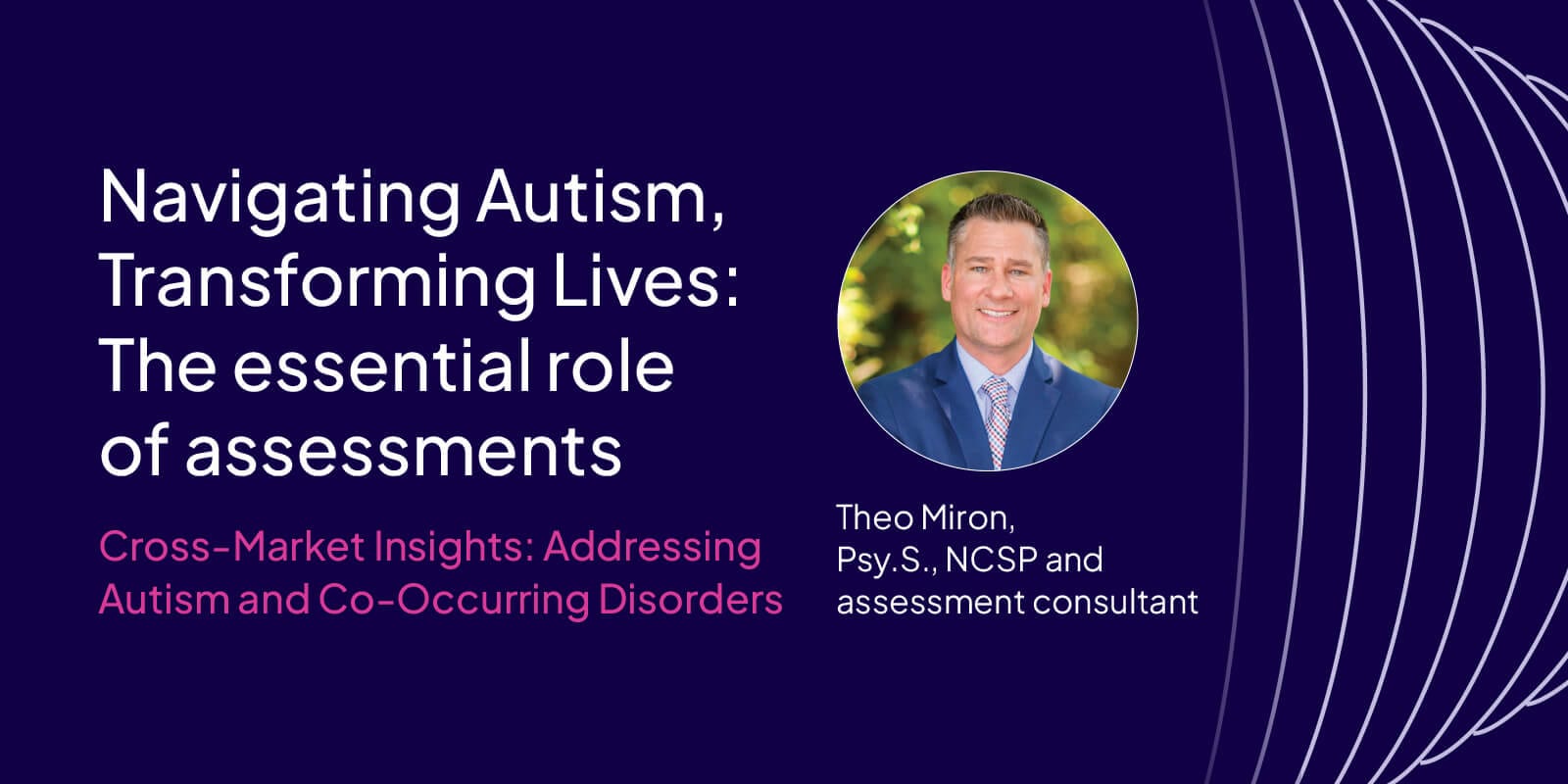
On June 17, global autism experts, researchers, educators and families in the autism community will gather at Pearson’s Virtual Autism Summit. For Clay Richey, who leads product development for Pearson Clinical Assessment, the event holds special meaning.
WAIS®-5 and WMS®-5 Together to Assess Cognition and Memory
In the poem “The Blind Men and the Elephant,” by John Godfry Saxe, six men set out to learn about an elephant and all six of them have different perceptions based on the different parts of the elephant they experienced and argued their points mightily. “Though each was partly in the right. And all were in the wrong!” Professionals who utilize psychological assessments in their practice are very much in danger of being ‘partially right but in the wrong’ by limiting their testing to a narrow scope of cognitive functioning. The Wechsler Adult Intelligence Scale®, Fifth Edition (WAIS®-5) and the Wechsler Memory Scale®, Fifth Edition (WMS®-5) provide clinicians with a battery of tests that sample a range of cognitive functions and have psychometric properties that allow for the integration of test results across batteries for enhanced interpretations.
Dyslexia affects 20% of the general population. However, that rate soars to nearly 50% among supervised individuals in correctional institutions, according to long-standing research.
As a language-based learning difference, dyslexia impairs reading, writing and processing information challenging for those affected. This difficulty can significantly impede an individual’s rehabilitation progress, whether under supervision or after release. In fact, research shows a strong connection between dyslexia, illiteracy and recidivism.
With correctional facilities increasingly focused on preventing recidivism, leaders are recognizing that early identification of dyslexia among supervised individuals is critical.
Safety and regulatory compliance practices are critical to keeping employees out of harm’s way and employers on the right side of the law. They’re also foundational to organizational productivity. That’s especially true in high-risk industries, where safety incidents can slow or stop normal operations.
Employees are more engaged when their workplaces are safe, and engaged employees are more productive. Safety, compliance, and productivity form a virtuous cycle: Safe employees are engaged and productive, and engaged employees do their part to ensure continued safety and compliance.
The question for many organizations is: How do you kick-start this cycle?
One answer is to use personality and mental health assessments to identify the best candidates for the job, as well as to provide continuous support for their mental health and well-being.
Employees’ personality traits and psychological states directly impact their safety. For example, research shows that neuroticism can negatively influence safety behavior, while conscientiousness positively influences it.
Employers can use personality and mental health assessments to uncover valuable information that they can use to tailor their team structure, training, and support resources based on their workers’ unique strengths and needs, enhancing both individual well-being and organizational effectiveness.
The key is understanding what assessments to use and how to use them.
Everyone has heard the old expression “time is money”, well, when you're working with a big caseload and you've got a lot of ground to cover, your time is probably your most precious commodity, so you need to spend it wisely. The Bruininks-Oseretsky Test of Motor Proficiency™, Third Edition (BOT™-3) provides many avenues for practitioners to do just that, by customizing their evaluations to meet the specific needs of clients and their individual circumstances.
We are proud to announce the new Call for Research published by Pearson Clinical Assessment. Our goal is to ensure that Pearson assessments comply with the highest standards of quality and support research that investigates the validity or efficacy of our products. We are inviting United States-based faculty members, graduate students, and qualified researchers to submit their proposals no later than August 15, 2025.
Tracking cognitive functioning remains a critical part of Alzheimer’s disease (AD) and dementia research. When used properly, COAs offer valuable insights into patients’ conditions, helping researchers track patients’ progress and assess a drug’s efficacy throughout clinical trials.
However, choosing suboptimal scales can be catastrophic for clinical research. The cognitive scales used in the majority of clinical trials for AD, for example, have been pivotal to the failure of 98% of Phase 2 and 3 clinical trials.
In this blog, we’ll discuss how COAs can make or break clinical trial outcomes and share how sponsors can select the optimal scales for their AD clinical research programs.
Comorbidities are common in autism. Some data suggest that almost 78 percent of autistic children have at least one co-occurring condition (and nearly half of children have two or more). The likelihood of experiencing comorbidities increases with age.