

Field Research Examiner Hub
Field Research Examiner Hub
Field Research Examiner Hub
Field Research Examiner Hub
Important Project Information
The WISC-6 standardization project is now about halfway through data collection, which means our recruitment needs have become much more targeted. Please continue to recruit and add diverse candidates to your Portal. We especially need candidates from diverse ethnic backgrounds and lower-education households. Review our weekly needs emails for a list of our most up-to-date needs and active bonus opportunities!
Please check the WISC-6 Updates and Reminders section frequently to stay informed of any new information or required actions. If you have any questions, don’t hesitate to reach out to our team.
Digital Testing Reminders
- WISC-6 Standardization-Digital: Keyboard Functionality
- WISC-6 Standardization-Digital: Naming Speed Numeracy
WISC-6 Q&A Sessions
Administration and Scoring Reminders
Validity Tests
- While reviewing our WISC–V, WPPSI–IV, and WAIS-5 validity studies, we have noticed a number of administered items on which a query was needed but was not provided. Please review the Queries section in chapter 2 of the Administration and Scoring Manual to ensure you understand the guidelines for when to query, and make sure you are following these procedures. Failure to query when it is necessary results in missing data. Examiners who continue to fail to query when needed will not have these validity measures assigned to them in the future for this project.
Digital Tests
- Please do not use the stylus for any reason on any item for the Similarities, Vocabulary, Information, and Comprehension WISC-6 standardization subtests. Writing with the stylus makes these subtests unusable and missing. The study being conducted relies on the use of the voice-to-text feature and the keyboard to correct any errors the dictation makes, including incorrectly dictated words, homophones, or missing words. The sample size is precisely designed to examine special research questions for Similarities, Vocabulary, Information, and Comprehension, so using the stylus on any of these subtests results in the entire case being unusable.
Digit Span and Naming Speed Numeracy (Number) and the 6–7 Cultural Trend
- There is a temporary cultural trend in which some children and adolescents laugh or become distracted when hearing or saying the numbers 6 and 7 together. Other pairs of numbers (e.g., 4–1, 6–1, 5-6) are presently emerging on social media and among children at this time.
- Please write the following brief preparatory prompt in your manual and provide it immediately prior to Digit Span and Sample Item B of Naming Speed Numeracy (Number) until the current trend to emphasize 6–7 or other pairs of numbers diminishes.
- Say, This part has numbers, and you could hear or say (six and seven, four and one, [insert appropriate number pair]) together. If you feel like laughing, go ahead and get it out now. Then you can focus and do your best.
Pseudoword Repetition
- Ensure the child does not view the screen of the audio device. Phonetic spellings of the stimuli are printed on the record form. The audio file name can be matched to the printed pseudoword to ensure you use the correct audio stimuli.
- Do not record verbatim responses! Listen and score.
- The entire pseudoword must be pronounced correctly to earn 1 point. See chapter 3 of the manual to ensure that you are scoring accurately.
List Learning: Give credit for the plural or singular form of each word (e.g., “leg” instead of “legs” or “hands” instead of “hand”).
Visual Span: Watch this 30-second video (from the training video) on How to record and score Visual Span performance and review the scoring examples in the manual.
- If there is any incorrect picture/symbol selected the entire item is scored 0 in the Total Score Column. See example from manual.

- If there are no incorrect pictures/symbols selected, score 1 point for every correct picture/symbol that is selected. See the example from the manual.

- The discontinue rule for each task is 3 consecutive scores of 0. Each task should only be discontinued after 3 consecutive scores of 0 in the Total score column. Discontinuation of the subtest is not based on the scores in the Correct order column.
Naming Speed Numeracy and Naming Speed Literacy: If the time expires before the child finishes, record an X over the first unattempted element and record a note on the record form indicating the stop point.
Standardization is a part of the research process during which the normative data is collected, and test items and content are finalized for publication. This step is fundamental to ensuring our products are reliable and include quality data from diverse populations.
Qualified examiners and candidates
Examiners will be selected based on their profession, and candidates will be assigned based on project inclusion criteria and demographic needs.
Qualified professions include
- Clinical psychologist
- Counseling psychologist
- Educational diagnostician
- Neuropsychologist
- Psychometrist
- School psychologist
- Graduate student - psychology
Candidate groups needed
- Typically developing: ages 6–16
- Clinical groups: ages 6–16
- Intellectually gifted
- Mild intellectual disability
- Language disorder with receptive or expressive impairment
- Motor impairment
- Traumatic brain injury (TBI)
- Moderate intellectual disability: Study Complete
- Specific learning disorder-reading and written expression: Study Complete
- Attention-deficit/hyperactivity disorder (ADHD): Study Complete
- Autism spectrum disorder with language impairment: Study Complete
- Specific learning disorder-mathematics: Study Complete
- Autism spectrum disorder with no language impairment: Study Complete
- Specific learning disorder-reading: Study Complete
- English learners: Study Complete
Test administration
- WISC-6 Standardization assignments will be tested in a paper and digital format.
- If you are selected to give a digital assignment, Pearson will provide you with iPads and access to the Assess app to complete testing using Q-interactive.
- A digital consent form is required and is launched from the Candidate Profile or the Assignments tab of the Field Research Portal.
- A digital candidate demographic form is required and is launched from the Assignments tab of the Field Research Portal.
To avoid any delays in payments, please ensure that the consent form and candidate demographic form are completed and submitted for each candidate prior to testing.
Required Training and First Test Review
Training
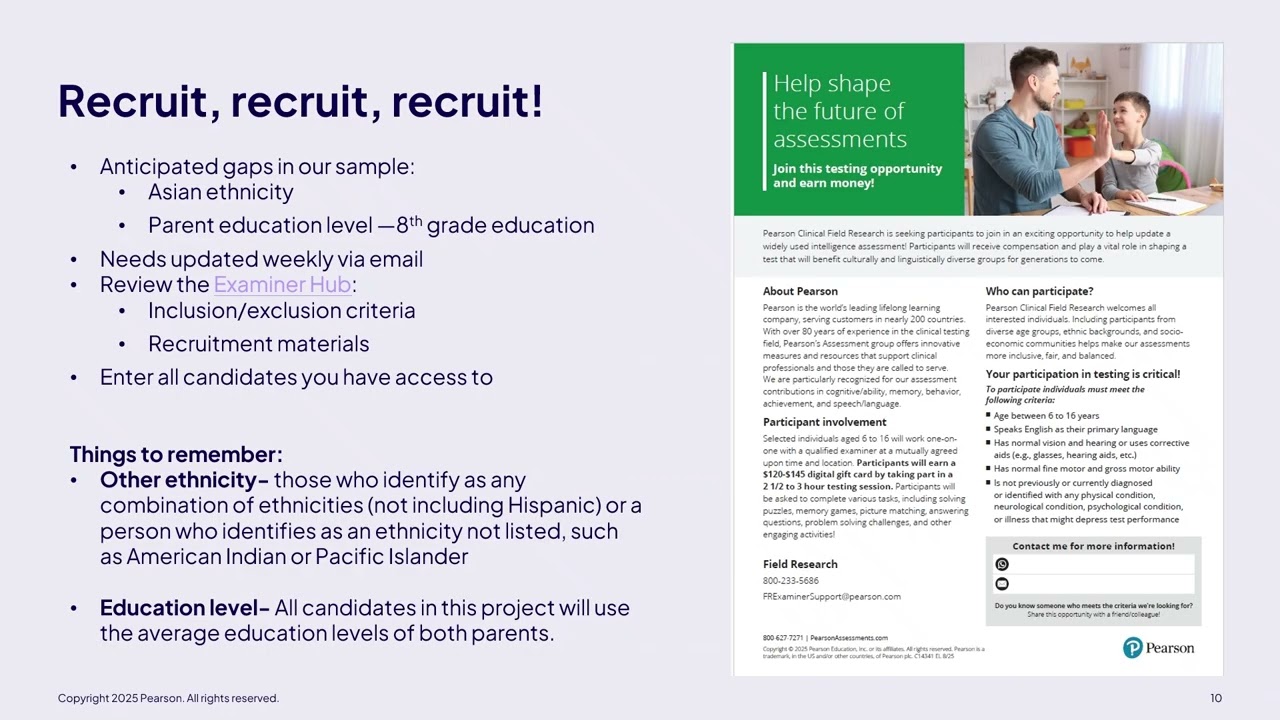
Examiners must complete training and receive a passing score on a mandatory quiz before WISC-6 assignments are released.
Training will take approximately 1 ½ hours (total video and quiz). Examiners will be paid $150 for training once they have passed the quiz with a 30/30 score. Additional directions can be found in the initial training email.
- WISC-6 Examiner Training Video: Please watch the training video in its entirety and thoroughly review the WISC-6 administration manual in the kit before proceeding to the training quiz.
- WISC-6 Test Kit: Please ensure you take inventory of your test kit and review the WISC-6 Standardization Kit Unboxing video to become familiar with the kit materials.
- WISC-6 Training Quiz: The link to the quiz will be provided to Examiners with confirmed assignments for the WISC-6. Do not complete the training video until you have received initial training/quiz details and a kit. The quiz link can be found in the initial training email.
- WISC-6 Digital VTT Training: If you are given a WISC-6 digital assignment, please review this VTT training. Failure to use VTT will result in an unusable test.
If you have not yet received the initial WISC-6 training email, please ensure you have added at least 2 to 5 test candidates in your Portal for us to review for participation. If you have already done so, please contact the Examiner Relations team at FRExaminerSupport@pearson.com and we will review your candidates for assignment.
 Play
Play
Privacy and cookies
By viewing this third-party content from www.youtube.com, you agree to their terms and conditions, privacy notice and acknowledge they may use cookies and pixels for information and analytics gathering.
| Training Pay | Completion Time | Examiner Pay |
|---|---|---|
| WISC-6 Training |
1 ½ hours |
$150 |
First test review
Examiners are required to wait for feedback and approval to continue testing after submitting their first test.
- Do not test any other candidates until you have received feedback from Pearson’s Content Development Team (contentdevfeedback@pearson.com).
- Feedback is generally provided via email within 5 business days from when the test is received by Pearson but may vary.
Become familiar with and bookmark this page. This is the go-to place for WISC-6 Standardization information and updates.
Before you begin:
- Review candidates within your Portal and ensure that those who are unavailable are marked as such in their candidate profile.
- Immediately take inventory of the kit when it arrives using the inventory checklist included in the box.
- Review the administration materials, including the WISC-6 Standardization Administration Manual.
- Complete the required training and receive a passing score on the mandatory quiz.
After receiving your first assignment:
- Review the assignment requirements within the Assignments tab of the Field Research Portal.
- If selected to give a digital assessment, you will see that two practice tests are included in the Assess app. Do not complete the practice tests with any assigned or potential candidates for the WISC-6 Standardization.
- Launch and receive the required parent/guardian annual consent form before scheduling testing.
- Launch the WISC-6 candidate demographic form to the parent/guardian from the Assignments tab of the Field Research Portal. This is required for each candidate.
A mismatch between the information entered in the Field Research Portal and the candidate demographic form could result in a test being unusable. Be thorough and verify that all information entered in the Field Research Portal is accurate and specific to that candidate.
During the data collection:
- Review assignment due dates in the Field Research Portal. The due date is the day we should receive the completed protocols at Pearson.
- Request an extension if you are unable to return completed test protocols prior to the due date by leaving a comment in the Field Research Portal or emailing FRExaminerSupport@pearson.com.
- Decline your assignment in the Field Research Portal if you are unable to complete the assignment or if your candidate is no longer available.
- Send one test protocol per mailing envelope and save your tracking numbers. Enter the assignment tracking number in the Field Research Portal within the assignment comment section after you have mailed it in.
Examinees will be compensated with a digital gift card of their choosing from the following options: Digital Gift Card Catalog. Examinees will select whether to receive payment via text or email when completing the candidate demographic form.
Payment will be withheld if the candidate demographic form and consent form are not completed prior to testing. The demographic form must be completed directly by an adult candidate or the parent/guardian of a child candidate, and must include a phone number or email unique to the participant.
Examinee payments will be sent directly to the candidate or parent/guardian. Examiners are not permitted to receive payments on behalf of candidates or distribute them. Please review the Examinee Digital Gift Card FAQs.
WISC-6 Bonus Opportunities
WISC-6 Standardization |
Age |
Administration time in minutes* |
Examiner pay |
Examinee pay |
|---|---|---|---|---|
WISC-6: Paper |
6–16 |
190 |
$300 |
$120 |
WISC-6: Paper: average parent education of 8th grade education** |
6–16 |
190 |
$325 |
$145 |
| WISC-6: Digital | 6–16 | 155 | $250 | $100 |
| WISC-6: Digital: average parent education of 8th grade education** | 6–16 | 155 | $275 | $125 |
WISC-6: Paper 2nd |
6–16 |
190 |
$300 |
$120 |
WISC-6: Digital 2nd |
6–16 |
30 |
$50 |
$50 |
| WISC-V PLUS validity/counterbalance |
6–16 |
160 |
$250 |
$100 |
| WPPSI-IV validity/counterbalance |
6–7:7 |
111 |
$175 |
$75 |
WAIS-5 |
16-16:11 |
150 |
$250 |
$100 |
WIAT-4 validity |
6–16 |
150 |
$250 |
$100 |
KTEA-3 Form A validity |
6–16 |
150 |
$250 |
$100 |
Home Environment Questionnaire |
6–16 |
45 |
- |
$25 |
New Pay Rates Effective May 14, 2026
Pay rates for Intellectually Gifted and Mild/Moderate Intellectual Disability studies have been updated. Review the details here: WISC-6 Clinical Pay Updates
WISC-6 Standardization |
Age |
Administration time in minutes* |
Examiner pay |
Examinee pay |
|---|---|---|---|---|
WISC-6: Paper - intellectually gifted |
6–16 |
190 |
$400 |
$200 |
| WISC-6: Digital - intellectually gifted | 6–16 | 155 | $400 | $200 |
WISC-6: Paper - mild intellectual disability |
6–16 |
190 |
$400 |
$200 |
| WISC-6: Digital - mild intellectually disability | 6–16 | 155 | $400 | $200 |
WISC-6: moderate intellectual disability |
6–16 |
190 |
$400 |
$200 |
WISC-6: specific learning disorder-reading |
6–16 |
190 |
$325 |
$145 |
WISC-6: specific learning disorder-reading and written expression |
6–16 |
190 |
$325 |
$145 |
WISC-6: specific learning disorder-mathematics |
6–16 |
190 |
$325 |
$145 |
WISC-6: ADHD |
6–16 |
190 |
$300 |
$120 |
WISC-6: autism spectrum disorder with language impairment |
6–16 |
190 |
$325 |
$145 |
| WISC-6: Paper - autism spectrum disorder with no language impairment | 6–16 |
190 |
$325 |
$145 |
| WISC-6: Digital - autism spectrum disorder with no language impairment | 6–16 | 190 | $275 | $125 |
WISC-6: English learners |
6–16 |
190 |
$325 |
$145 |
WISC-6: language disorder with receptive impairment |
6–16 |
190 |
$325 |
$145 |
WISC-6: language disorder with expressive impairment |
6–16 |
190 |
$325 |
$145 |
WISC-6: motor impairment |
6–16 |
190 |
$325 |
$145 |
WISC-6: TBI |
6–16 |
190 |
$400 |
$200 |
WISC-6 Standardization |
Age |
Administration time in minutes* |
Examiner pay |
Examinee pay |
|---|---|---|---|---|
WIAT-4 Validity: specific learning disorder-reading |
6–16 |
150 |
$250 |
$150 |
WIAT-4 Validity: specific learning disorder-reading and written expression |
6–16 |
150 |
$250 |
$150 |
WIAT-4 Validity: specific learning disorder-mathematics |
6–16 |
150 |
$250 |
$150 |
CELF-5 Validity: language disorder with receptive impairment |
6–16 |
45 |
$125 |
$100 |
CELF-5 Validity: language disorder with expressive impairment |
6–16 |
45 |
$125 |
$100 |
WISC-6 Standardization |
Age |
Administration time in minutes* |
Examiner pay |
Parent pay |
|---|---|---|---|---|
Vineland-3 Caregiver Validity: mild intellectual disability |
6–16 |
75 |
$25 |
$50 |
Vineland-3 Caregiver Validity: moderate intellectual disability |
6–16 |
75 |
$25 |
$50 |
Vineland-3 Caregiver Validity: motor impairment |
6–16 |
75 |
$25 |
$50 |
Vineland-3 Caregiver Validity: TBI |
6–16 |
75 |
$25 |
$50 |
BASC-3 Caregiver Validity: ADHD |
6–16 |
45 |
$25 |
$30 |
BASC-3 Caregiver Validity: autism spectrum disorder with language impairment |
6–16 |
45 |
$25 |
$30 |
BASC-3 Caregiver Validity: autism spectrum disorder with no language impairment |
6–16 |
45 |
$25 |
$30 |
*Administration time is the average time expected to complete the evaluation including building rapport and allowing breaks. This can fluctuate depending on the candidate's attention level and/or clinical needs.
** For this project, education level is determined by the average of both parents. See the parent education average table to verify if your candidate qualifies. Candidates whose caregivers have an 8th grade education or less are eligible for a higher pay rate due to potential challenges associated with recruitment.
Test–retest and Validity Assignments
Some examiners may receive test–retest and/or validity assignments along with the WISC-6 Standardization. Some validity assignments are part of a counterbalance study in which the WISC-6 Standardization is administered after the validity test. Should your candidate be selected for one of these assignments, our team will ensure you have the materials needed.
Please carefully review the testing intervals below. You will also find the testing intervals within the Requirements section of the assigned validity/counterbalance test in the Field Research Portal. Tests completed out of interval will be unusable. (To calculate intervals, the day you give the first test is day zero.)
- WISC-6 retest: the second administration of the WISC-6 should be completed 14 to 49 days after the first WISC-6.
- WPPSI-IV validity: administer the WISC-6 first; the WPPSI-IV should be administered 14 to 49 days after the WISC-6.
- WISC-V validity: administer the WISC-6 first; the WISC-V should be administered 14 to 49 days after the WISC-6.
- WAIS-5 validity: administer the WISC-6 first; the WAIS-5 should be administered 14 to 49 days after the WISC-6.
- WPPSI-IV counterbalance: administer the WPPSI-4 first; the WISC-6 should be administered 14 to 49 days after the WPPSI-IV.
- WISC-V counterbalance: administer the WISC-V first; the WISC-6 should be administered 14 to 49 days after the WISC-V.
- WISC-V counterbalance: administer the WISC-V first; the WISC-6 should be administered 14 to 49 days after the WISC-V.
- WAIS-5 counterbalance: administer the WAIS-5 first; the WISC-6 should be administered 14 to 49 days after the WAIS-5.
- KTEA-3 validity: administer the KTEA-3 the same day or up to 49 days after the WISC-6.
- WIAT-4 validity: administer the WIAT-4 the same day or up to 49 days after the WISC-6.
Clinical Validity Assignments
- BASC-3 validity: administer the BASC-3 the same day or up to 49 days after the WISC-6.
- Vineland-3 validity: administer the Vineland-3 the same day or up to 49 days after the WISC-6.
- WIAT-4 validity: administer the WIAT-4 the same day or up to 49 days after the WISC-6.
- CELF-5 validity: administer the CELF-5 the same day or up to 49 days after the WISC-6.
Typically Developing Candidate Criteria
Inclusion
The candidate must
- speak English as their primary language (the language most often spoken).
- have normal vision and hearing or examinee uses corrective aids (e.g., glasses, hearing aids, etc.).
- have normal fine motor and gross motor ability.
Exclusion
The candidate must not
- be a close friend, relative, or ward of the examiner, or child with whom the examiner lives.
- be an identical sibling of another child in the sample.
- have a history of electroconvulsive therapy or radiation treatment of the central nervous system.
- have received chemotherapy in the past 2 months.
- be primarily nonverbal or uncommunicative.
- have tested on any intelligence measure in the previous 6 months (not applicable to the ID study).
- have tested on the WISC-6 pilot edition.
- be currently admitted to a hospital or psychiatric facility.
- be currently taking medication that might impact cognitive test performance (e.g., anticonvulsants, antipsychotics, some antidepressants and anxiolytics. View Excluded Medication List here.
- have a history of a period of unconsciousness not related to surgery or greater than 20 minutes related to a medical condition.
- be previously or currently diagnosed or identified with any physical condition, neurological condition, psychological condition, or illness that might depress test performance, such as
- intellectual disability (not applicable to the ID study).
- specific learning disorder
- attention deficit/hyperactivity disorder
- autism spectrum disorder
- language disorder
- stroke
- epilepsy
- traumatic brain injury
- mood disorder
Test scores are required to support the diagnosis to be included in a clinical study. Enter scores in the Field Research Portal within the candidate profile under Clinical Diagnostic Information.
Intellectually Gifted
To be included in the intellectually gifted study group, a candidate must:
- be ages 6 to 16
- provide a full-scale score ≥ 2 standard deviations (SDs) above the mean on a comprehensive, individually administered measure of intellectual ability (e.g., IQ ≥ 130).
- For candidates ages 6–9, the score must be ≤ 2 years old.
- For candidates ages 10–14, the score must be ≤ 3 years old.
- For candidates ages 15–16, the score must be ≤ 5 years old.
- presently or in the past received services for intellectual giftedness in school.
Additional information:
The candidate must not meet any exclusion criteria as outlined in the Typically Developing Candidate Criteria section.
Mild Intellectual Disability
To be included in the mild intellectual disability study group, a candidate must:
- be ages 6 to 16.
- be diagnosed with intellectual disability, mild severity.
- provide a full-scale score 2–3 SDs below the mean (e.g., FSIQ 55–70) on a comprehensive, individually administered measure of intellectual ability such as: WPPSI, WISC, WAIS, KABC, DAS, Stanford Binet 5, WJ-IV or WJ-5. Screeners such as WASI, RIAS, CAS, and KBIT are not acceptable.
- For candidates ages 6–9, the score must be ≤ 2 years old.
- For candidates ages 10–14, the score must be ≤ 3 years old.
- For candidates ages 15–16, the score must be ≤ 5 years old.
- have adaptive deficits that limit functioning in one or more of the activities of daily life identified by DSM–5 (e.g., communication, social participation, and independent living) across multiple environments (e.g., home, school, work, and recreation).
Additional information:
The candidate must not meet any exclusion criteria as outlined in the Typically Developing Candidate Criteria section, except those related to a clinical diagnosis as described here.
- The candidate may have comorbid ADHD, depression, and anxiety disorders.
- The candidate may currently be taking antidepressants or psychostimulants.
Moderate Intellectual Disability
To be included in the moderate intellectual disability study group, the candidate must:
- be ages 6 to 16.
- be diagnosed with intellectual disability, moderate severity.
- provide a full-scale score 3–4 SDs below the mean (e.g., FSIQ 40–55) on a comprehensive, individually administered measure of intellectual ability such as: WPPSI, WISC, WAIS, KABC, DAS, Stanford Binet 5, WJ-IV or WJ-5. Screeners such as WASI, RIAS, CAS, and KBIT are not acceptable.
- For candidates ages 6–9, the score must be ≤ 2 years old.
- For candidates ages 10–14, the score must be ≤ 3 years old.
- For candidates ages 15–16, the score must be ≤ 5 years old.
- have adaptive deficits that limit functioning in one or more of the activities of daily life identified by DSM–5 (e.g., communication, social participation, and independent living) across multiple environments (e.g., home, school, work, and recreation).
Additional information:
The candidate must not meet any exclusion criteria as outlined in the Typically Developing Candidate Criteria section, except those related to a clinical diagnosis as described below.
- The candidate may have comorbid ADHD, depression, and anxiety disorders.
- The candidate may currently be taking antidepressants or psychostimulants.
Specific Learning Disorder-Reading
To be included in the specific learning disorder-reading study group, the candidate must:
- be ages 6 to 16.
- be diagnosed with specific learning disorder with impairment in reading (most recent DSM) or identified with learning disability in reading or dyslexia.
- provide a full-scale score on a standardized, individually administered measure of cognitive ability that is greater than or equal to 80 OR submit documentation that a psychologist has estimated IQ as greater than or equal to 80.
- For candidates ages 6–9, the score must be ≤ 2 years old.
- For candidates ages 10–14, the score must be ≤ 3 years old.
- For candidates ages 15–16, the score must be ≤ 5 years old.
- provide scores that display a pattern of strengths and weaknesses in cognitive processing and achievement consistent with specific learning disability in reading OR submit scores that show a discrepancy of 15 points or more between cognitive ability and reading achievement on comprehensive measures of cognitive ability and achievement.
- For candidates ages 6–9, the score must be ≤ 1 year old.
- For candidates ages 10–14, the score must be ≤ 2 years old.
- For candidates ages 15–16, the score must be ≤ 3 years old.
Additional information:
The candidate must not meet any exclusion criteria as outlined in the Typically Developing Candidate Criteria section. See exceptions and specific notes related to the clinical diagnosis below.
- Reading comprehension cannot be the only reading skill impairment.
- The candidate must not have a comorbid disorder of SLD-written expression, SLD-math, or ADHD.
Specific Learning Disorder-Reading and Written Expression
To be included in the specific learning disorder-reading and written expression study group, the candidate must:
- be ages 6 to 16.
- be diagnosed with specific learning disorder in reading and written expression (most recent DSM) or identified with learning disorder with impairment in reading and written expression.
- have comorbid diagnoses or identification of both specific learning disorders in reading and written expression.
- provide a full-scale score on a comprehensive, individually administered measure of cognitive ability that is greater than or equal to 80 OR submit documentation that a psychologist has estimated IQ as greater than or equal to 80.
- For candidates ages 6–9, the score must be ≤ 2 years old.
- For candidates ages 10–14, the score must be ≤ 3 years old.
- For candidates ages 15–16, the score must be ≤ 5 years old.
- provide scores that display a pattern of strengths and weaknesses in cognitive processing and achievement consistent with specific learning disability in reading and written expression OR submits scores that show a discrepancy of 15 points or more between cognitive ability and reading and written expression on standardized measures of cognitive ability and achievement.
- For candidates ages 6–9, the score must be ≤ 1 year old.
- For candidates ages 10–14, the score must be ≤ 2 years old.
- For candidates ages 15–16, the score must be ≤ 3 years old.
Additional information:
The candidate must not meet any exclusion criteria as outlined in the Typically Developing Candidate Criteria section. See exceptions and specific notes related to the clinical diagnosis below.
- Reading comprehension cannot be the only reading skill impairment.
- The candidate must not have comorbid SLD-math or ADHD.
Specific Learning Disorder-Mathematics
To be included in the specific learning disorder-mathematics study group, the candidate must:
- be ages 6 to 16.
- be diagnosed with specific learning disorder with impairment in mathematics (most recent DSM) or identified with learning disability in mathematics or dyscalculia.
- provide a full-scale score on a comprehensive, individually administered measure of cognitive ability that is greater than or equal to 80 OR submit documentation that a psychologist has estimated IQ as greater than or equal to 80.
- For candidates ages 6–9, the score must be ≤ 2 years old.
- For candidates ages 10–14, the score must be ≤ 3 years old.
- For candidates ages 15–16, the score must be ≤ 5 years old.
- provide scores that display a pattern of strengths and weaknesses in cognitive processing and achievement consistent with specific learning disability in mathematics OR submit scores that show a discrepancy of 15 points or more between cognitive ability and mathematics achievement on comprehensive measures of cognitive ability and achievement.
- For candidates ages 6–9, the score must be ≤ 1 year old.
- For candidates ages 10–14, the score must be ≤ 2 years old.
- For candidates ages 15–16, the score must be ≤ 3 years old.
Additional information:
The candidate must not meet any exclusion criteria as outlined in the Typically Developing Candidate Criteria section, including those listed below.
- The candidate must not have a comorbid disorder of SLD-reading, SLD-written expression or ADHD.
Attention-deficit/hyperactivity disorder
To be included in the attention-deficit/hyperactivity disorder study group, the candidate must:
- be ages 6 to 16.
- meet DSM-5 criteria for a diagnosis of ADHD combined presentation or ADHD predominantly inattentive presentation.
- have been evaluated for ADHD by a qualified mental health professional (psychologist or psychiatrist).
- not be in partial remission, as defined by the DSM-5 criteria.
- complete a 24-hour washout period if prescribed stimulant medication for ADHD symptoms. Non-stimulant drugs like Strattera, Intuniv, or Kapvay are acceptable.
Additional information:
The candidate must not meet any exclusion criteria as outlined in the Typically Developing Candidate Criteria section. See exceptions and specific notes related to the clinical diagnosis below.
- The candidate may be diagnosed with oppositional defiant disorder or conduct disorder.
- The candidate must not be diagnosed with any psychiatric condition other than ADHD combined presentation or ADHD predominantly inattentive presentation.
Autism spectrum disorder with language impairment
To be included in the autism spectrum disorder with language impairment study group, the candidate must:
- be ages 6 to 16.
- meet DSM-5 criteria for autism spectrum disorder with language impairment.
- be diagnosed with ASD by a qualified mental health professional or developmental pediatrician.
- have adequate language skills to complete testing.
- be able to take the test in a standard manner without modifications.
- have an FSIQ or general cognitive ability score on a comprehensive test of intellectual ability to verify cognitive functioning greater than or equal to 70.
Additional information:
The candidate must not meet any exclusion criteria as outlined in the Typically Developing Candidate Criteria section. See exceptions and specific notes related to the clinical diagnosis below.
- The candidate must not have a comorbid diagnosis of:
- autism spectrum disorder with catatonia
- intellectual disability
- Down syndrome
- Rett disorder
- fragile X syndrome
- Turner syndrome
- Williams syndrome
- The candidate must not have a diagnosis of fetal alcohol syndrome, fetal alcohol effects, or other prenatal drug/alcohol exposure.
- Comorbid diagnoses of attention-deficit/hyperactivity disorder, oppositional defiant disorder, conduct disorder, and other disruptive, impulse-control, and conduct disorders are acceptable as long as compliance with testing is sufficient to ensure a valid assessment.
- If the candidate is prescribed stimulant medication for ADHD symptoms, a 24-hour washout period is required. (Non-stimulant drugs like Strattera, Intuniv, or Kapvay are acceptable.)
Autism spectrum disorder with no language impairment
To be included in the autism spectrum disorder with no language impairment study group, the candidate must:
- be ages 6 to 16.
- meet DSM-5 criteria for autism spectrum disorder without language impairment.
- be diagnosed with ASD by a qualified mental health professional or developmental pediatrician.
- have adequate language skills to complete testing.
- be able to take the test in a standard manner without modifications.
- have an FSIQ or general cognitive ability score on a comprehensive test of intellectual ability to verify cognitive functioning greater than or equal to 70.
Additional information:
The candidate must not meet any exclusion criteria as outlined in the Typically Developing Candidate Criteria section. See exceptions and specific notes related to the clinical diagnosis below.
- The candidate must not have a comorbid diagnosis of:
- autism spectrum disorder with catatonia
- intellectual disability
- Down syndrome
- Rett disorder
- fragile X syndrome
- Turner syndrome
- Williams syndrome
- The candidate must not have a diagnosis of fetal alcohol syndrome, fetal alcohol effects, or other prenatal drug/alcohol exposure.
- Comorbid diagnoses of attention-deficit/hyperactivity disorder, oppositional defiant disorder, conduct disorder, and other disruptive, impulse-control, and conduct disorders are acceptable as long as compliance with testing is sufficient to ensure a valid assessment.
- If the candidate is prescribed stimulant medication for ADHD symptoms, a 24-hour washout period is required. (Non-stimulant drugs like Strattera, Intuniv, or Kapvay are acceptable.)
Language Disorder with Receptive Impairment
To be included in the language disorder with receptive impairment study group, the candidate must:
- be ages 6 to 16.
- be diagnosed or identified with a language disorder with receptive language impairment.
- be receiving speech-language services.
- provide scores that are 1.5 SDs or greater below the mean on the total language or core index score AND the receptive scores of a standardized test of language abilities such as the CELF or PLS.
- For candidates ages 6–9, the score must be within 1 year of test date.
- For candidates ages 10–14, the score must be within 2 years of test date.
- For candidates ages 15–16, the score must be within 3 years of test date.
Additional information:
The candidate must not meet any exclusion criteria as outlined in the Typically Developing Candidate Criteria section. See exceptions and specific notes related to the clinical diagnosis below.
- Comorbid diagnoses of social (pragmatic) communication disorder and expressive language disorder are acceptable.
- The candidate must not have a diagnosis of ADHD.
Language Disorder with Expressive Impairment
To be included in the language disorder with expressive impairment study group, the candidate must:
- be ages 6 to 16.
- be diagnosed or identified with an expressive language disorder.
- be receiving speech-language services.
- provide scores that are 1.5 SDs or greater below the mean on the total language or core index score AND the expressive scores of a standardized test of language abilities such as the CELF or PLS.
- For candidates ages 6–9, the score must be within 1 year of test date.
- For candidates ages 10–14, the score must be within 2 years of test date.
- For candidates ages 15–16, the score must be within 3 years of test date.
Additional information:
The candidate must not meet any exclusion criteria as outlined in the Typically Developing Candidate Criteria section. See exceptions and specific notes related to the clinical diagnosis below.
- The candidate must not have a diagnosis of receptive language disorder or ADHD.
- Comorbid diagnoses of social (pragmatic) communication disorder is acceptable.
Motor Impairment
To be included in the motor impairment study group, the candidate must:
- be ages 6 to 16.
- have a diagnosis of mild to moderate cerebral palsy, developmental coordination disorder, or has a documented motor delay in educational or medical records.
- be able to participate fully in testing without the use of an assistive device for mobility/walking.
Additional information:
The candidate must not meet any exclusion criteria as outlined in the Typically Developing Candidate Criteria section, including those listed below.
- The candidate must not have a diagnosis of Down syndrome, intellectual disability, ADHD or autism spectrum disorder.
- The candidate’s primary diagnosis must not be developmental delay or drug/alcohol exposure.
- The candidate must not have a physical condition, health condition (e.g. recent surgeries, doctor's orders to restrict activity), illness, or impairment that would preclude participation in testing.
- The candidate must not be taking medications that would impact performance areas addressed by the assessment (e.g. balance, coordination, memory).
Traumatic Brain Injury
To be included in the traumatic brain injury study group, the candidate must:
- be ages 6 to 16.
- be diagnosed with traumatic brain injury (TBI).
- have had a premorbid or estimated premorbid IQ greater than 70 (i.e., did not fall in the intellectual disability range prior to injury).
Additional information:
The candidate must not meet any exclusion criteria as outlined in the Typically Developing Candidate Criteria section. See exceptions and specific notes related to the clinical diagnosis below.
- The candidate cannot be diagnosed with a concussion.
- Oppositional–defiant disorder, conduct disorder, and other disorders in the disruptive, impulse–control, and conduct disorders category are acceptable as long as compliance with testing is sufficient to ensure a valid assessment.
- The candidate can be on medication consistent with TBI diagnosis.
English Learners
To be included in the English learners study group, the candidate must:
- be ages 6 to 16.
- be identified as an English Learner through one of the following:
- is receiving school services for Limited English Proficiency (LEP).
- is identified as an English Language Learner (ELL) by parent report.
- is identified as preferring to communicate in a language other than English in a variety of settings (e.g., home, community, school setting when not in the classroom).
- understand and speak other language more frequently than English, based upon parent/guardian report.
- be able to take the test in a standard manner without modifications.
Additional information:
The candidate must not meet any exclusion criteria as outlined in the Typically Developing Candidate Criteria section, including those listed below.
- The candidate must not have a primary diagnosis that negatively impacts language abilities (e.g., ID, ASD).
- The candidate must not have a diagnosis of hearing impairment, aided or unaided.
- The candidate must not have a diagnosis of ADHD.
Project Tutorials and Important Documents
Training
Digital Testing Reminders
- WISC-6 Standardization-Digital: Keyboard Functionality
- WISC-6 Standardization-Digital: Naming Speed Numeracy
Audio Files
- How to Download and Access WISC-6 Standardization Audio Files
- WISC-6 Standardization Audio Files
- WIAT-4 Audio Files
- KTEA-3 Audio Files
WISC-6 Q&A Sessions
Other
Important Project Updates
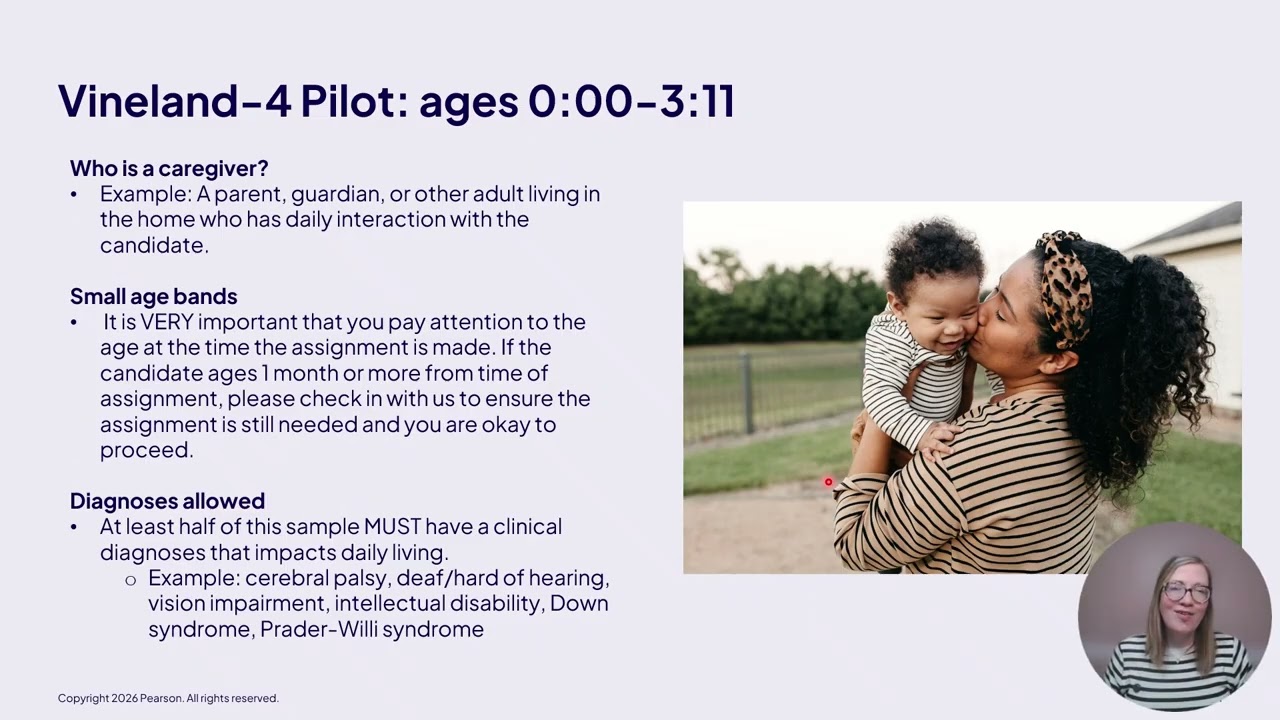
This will be a “Flash Data Collection!” Interested examiners must be available to complete testing within tight turnaround times between August and November. Pilots have smaller collections, so a limited number of Examiners will be selected. To get started, please focus on recruiting candidates that meet the following needs:
Birth –2-year-olds who are Asian, Hispanic, Other, or Black and whose parent education average is some college, an associate degree, or less
- Candidates must have a diagnosis or have a suspected behavior deficit. Examples of a suspected behavior deficit include, but are not limited to, prematurity, extended NICU stay, low birth weight, and delayed milestones.
Our team is here to support you! Please check the Vineland-4 Updates and Reminders section frequently to stay informed of any new information or required actions. If you have any questions, don’t hesitate to reach out to our team.
Interested in participating? If you are a qualified professional with eligible candidates, please complete the “Interest Survey” located in your Vineland-4 Invite within your Portal account.
Vineland-4 Updates and Reminders
Administration Reminders
Vineland-4 Q&A
A pilot is a smaller study performed before a large standardization study to help decide test items, test order, or other functional aspects of the test. This is a crucial step in the research process because it helps us ensure our products are relevant, clear, and effective.
Qualified Examiners and Candidates
Examiners will be selected based on their profession, and candidates will be assigned based on project inclusion criteria and demographic needs. Preference will be given to Examiners with experience giving the Vineland-3.
Qualified professions include:
- occupational therapists
- clinical psychologists
- clinical social workers
- educational diagnosticians
- neuropsychologists
- school psychologists
- psychometrists
- developmental‑behavioral pediatricians
- board certified behavior analyst (BCBA)
Candidate groups needed
- Typically developing:
- Ages 0-15 for the Caregiver Interview and Digital Caregiver Form assignments
- Ages 16-65 for Caregiver Interview, Digital Caregiver Form, and Self Interview
- Candidate must have a job or regular weekly volunteer role
- Clinical groups: ages 0-3
- Any diagnosed disability or condition related to physical, sensory, intellectual/developmental, genetic/chromosomal, and mental health/behavioral domains that impact adaptive functioning in daily activities
Test Administration
- Vineland-4 Pilot assignments will be tested in a paper format.
- A digital consent form is required and is launched from the Candidate Profile or the Assignments tab of the Field Research Portal.
- A digital candidate demographic form is required and is launched from the Assignments tab of the Field Research Portal.
To avoid payment delays, please ensure the consent form and candidate demographic form are completed and submitted for each candidate prior to testing.
Required Training and First Test Review
Training
Examiners must complete training and receive a passing score on a mandatory quiz before Vineland-4 assignments are released.
Training will take approximately 1 ½ hours (total video and quiz). Examiners will be paid $150 for training once they have passed the quiz with a 30/30 score. Additional directions can be found in the initial training email.
- Vineland-4 Examiner Training Video: Please watch the training video in its entirety and thoroughly review the Vineland-4 Pilot Examiner’s manual before proceeding to the training quiz.
- Vineland-4 Test Kit: Please ensure you take inventory of your test kit and become familiar with the kit materials. Download and review the Vineland-4 Pilot Examiner’s Manual.
- Vineland-4 Training Quiz: The training quiz is only available to Examiners with confirmed Vineland-4 candidates and assignments. Once your candidate and assignment have been confirmed and your kit has been shipped, you will receive an email with your initial training instructions and a link to the quiz. Please do not complete the training video until you have received this email and your kit.
Please add 2 to 5 test candidates to your Portal for our review to be considered for participation. If you have any questions, please contact us at FRExaminerSupport@pearson.com.
 Play
Play
Privacy and cookies
By viewing this third-party content from www.youtube.com, you agree to their terms and conditions, privacy notice and acknowledge they may use cookies and pixels for information and analytics gathering.
| Training Pay | Completion Time | Examiner Pay |
|---|---|---|
| Vineland-4 Training | 1 ½ hours | $150 |
First Test Review
Examiners are required to wait for feedback and approval to continue testing after submitting their first test.
- Do not test any other candidates until you have received feedback from Pearson’s Content Development Team (ContentDevFeedback@Pearson.com).
- Feedback is generally provided via email 4–5 business days from when the test is received by Pearson, but may vary.
Become familiar with and bookmark this page. This is the go-to place for Vineland-4 information and updates.
Before you begin:
- Review candidates within your Portal and ensure that those who are unavailable are marked as such in their candidate profile.
- Immediately take inventory of the kit when it arrives using the inventory checklist included in the box.
- Review the administration materials, including the Vineland-4 Administration Manual.
- Complete the required training and receive a passing score on the mandatory quiz.
After receiving your first assignment:
- Review the assignment requirements within the Assignments tab of the Field Research Portal.
- Launch and receive the required parent/guardian annual consent form before scheduling testing.
- Launch the Vineland-4 candidate demographic form to the parent/guardian from the Assignments tab of the Field Research Portal. This is required for each candidate.
A mismatch between the information entered in the Field Research Portal and the candidate demographic form could result in a test being unusable. Be thorough and verify that all information entered in the Field Research Portal is accurate and specific to that candidate.
During the data collection:
- Review assignment due dates in the Field Research Portal. The due date is the day we should receive the completed protocols at Pearson.
- Request an extension if you are unable to return completed test protocols prior to the due date by leaving a comment in the Field Research Portal or emailing FRExaminerSupport@Pearson.com.
- Decline your assignment in the Field Research Portal if you are unable to complete the assignment or if your candidate is no longer available.
- Send one test protocol per mailing envelope and save your tracking numbers. Enter the assignment tracking number in the Field Research Portal within the assignment comment section after you have mailed it in.
Examinees will be paid digitally. The examinee will indicate on the candidate demographic form whether to receive payment via text or email. Payment will be withheld if the candidate demographic form and consent form are not completed prior to testing. For those under 18, the demographic form must be completed by the parent/guardian and must include a phone number or email unique to the candidate.
Examinee payments will be sent directly from Pearson to the candidate or the candidate's parent/guardian. Examiners are not permitted to receive payments on behalf of candidates or to distribute them. Please review the Examinee Digital Gift Card FAQs
| Vineland-4 Pilot Caregiver Participation |
Age |
Administration time in minutes* | Examiner Pay | Examinee Pay |
Caregiver Pay |
|---|---|---|---|---|---|
| Vineland-4 Interview Caregiver, Adult |
16-65 | 120 | $150 | $25 | $100 |
| Vineland-4 Interview Caregiver, Child | 4-15 | 90 | $100 | $25 | $80 |
| Vineland-4 Interview Caregiver, Infant | 0-3 | 120 | $200 | --- | $150 |
| Vineland-4 Caregiver Digital Form, Adult | 16-65 | 80 | $25 | $10 | $75 |
| Vineland-4 Caregiver Digital Form, Child | 4-15 | 40 | $25 | $10 | $50 |
| Vineland-4 Caregiver Digital Form, Infant | 0-3 | 40 | $25 | $10 | $50 |
| Vineland-4 Pilot Candidate Participation |
Age |
Administration time in minutes* | Examiner Pay | Examinee Pay |
|---|---|---|---|---|
| Vineland-4 Interview, Self-report | 16-65 | 120 | $150 | $100 |
*Administration time is the average time expected to complete the evaluation, including building rapport and allowing breaks. This can fluctuate depending on the caregiver’s/candidate's attention level and/or clinical needs.
Many assignments include caregiver involvement. You may be asked to complete an Interview with the caregiver or launch a digital Caregiver Form for them to complete.
Caregiver interviews must be conducted in person. The Caregiver Form can be sent digitally to the caregiver and completed without the Examiner present.
For those age 16-65, Caregiver really means another adult who lives in the home. This could be a parent, adult child, roommate, partner, sibling, etc.
To be eligible, the caregiver must:
- Be able to understand and respond to items presented verbally in English
- Have everyday contact-for at least the last 3 months-with the candidate, ideally living in the same home
- Typically a parent or other adult relative living with a child or teen candidate, or a parent, spouse/partner, adult child, or roommate living with an adult candidate
Typically Developing Candidate Criteria
Inclusion
The candidate must
- be able to understand and respond to items presented verbally in English
- for those age 16-65: have a paid job or consistent volunteer role (has similar expectations as a job), at least 10 hours a week, for at least 3 months
- for those age 0-3: candidates can have any diagnosed disability or condition related to physical (e.g., cerebral palsy, spina bifida), sensory (e.g., deaf, hard of hearing, vision impairment, blindness), intellectual/developmental (e.g., intellectual disability (ID), global developmental delay), genetic/chromosomal (e.g., Down syndrome, Prader-Willi syndrome, fragile X syndrome), and mental health/behavioral domains that impact adaptive functioning in daily activities (i.e., communication, daily living skills, socialization, motor skills).
Exclusion
The candidate must not
- be hospitalized or otherwise not living in a home environment
- for those age 16-65: have any diagnosed disability or condition related to physical, sensory, intellectual/developmental, and mental health/behavioral domains that impact adaptive functioning in daily activities (i.e., communication, daily living skills, socialization, motor skills)
- for those age 16-65: have an individualized education plan (IEP)
Autism Spectrum Disorder (ASD)
To be included in the ASD study group, a candidate:
- must be ages 16-65
- meets DSM-5 criteria for ASD
- was diagnosed with ASD by a qualified mental health professional or developmental pediatrician
- must be able to understand and respond to items presented verbally in English
- must have adequate language skills to complete testing
- may have comorbid diagnoses of attention-deficit/hyperactivity disorder (ADHD), oppositional defiant disorder, conduct disorder, and other disruptive, impulse-control, and conduct disorders as long as compliance with testing is sufficient to ensure a valid assessment
- may be on medication for assessment, but the type of medication must be documented
- must have no intellectual disability
Additional information:
The candidate must not meet any exclusion criteria as outlined in the Typically Developing Candidate Criteria section, except those related to a clinical diagnosis as described here:
- is diagnosed with a comorbid genetic disorder such as Down syndrome, Rett disorder, fragile X syndrome, Turner syndrome, or Williams syndrome
- is diagnosed with ID
- speech-language is so impaired that the candidate cannot respond to items
- is diagnosed with fetal alcohol syndrome, fetal alcohol effects, or other prenatal drug/alcohol exposure
- is diagnosed with any other physical, sensory, intellectual/developmental disability or condition that impacts adaptive behavior
Attention-Deficit/Hyperactivity Disorder (ADHD)
To be included in the ADHD study group, a candidate:
- must be ages 16-65
- must be able to understand and respond to items presented verbally in English
- meets DSM-5 criteria for a diagnosis of ADHD combined presentation, ADHD predominately hyperactive/impulsive presentation, or ADHD predominately inattentive presentation.
- has been evaluated for ADHD by a qualified mental health professional (psychologist or psychiatrist)
- may be on stimulant medication at time of testing (medication must be recorded)
Additional information:
The candidate must not meet any exclusion criteria as outlined in the Typically Developing Candidate Criteria section, except those related to a clinical diagnosis as described here:
- is diagnosed with any psychiatric condition other than ADHD combined presentation, ADHD predominately hyperactive/impulsive presentation, or ADHD predominately inattentive presentation
- is diagnosed with any other physical, sensory, intellectual/developmental disability or condition that impacts adaptive behavior
Project Tutorials and Important Documents
Training
Administration Reminders
Vineland-4 Q&A
Other
Important Project Updates
The BASC-4 CPT standardization will begin with a small initial collection in October. This will be a “flash collection,” so examiner spots will be limited. Interested examiners must be able to complete testing within tight turnaround times between October and December.
Interested in participating? If you are a qualified professional with eligible candidates, please complete the Interest Survey located in your BASC-4 CPT invite within your Field Research Portal account.
Standardization is a part of the research process during which the normative data is collected and test items and content are finalized for publication. This step is fundamental to ensure our products are reliable and include quality data from diverse populations.
Qualified Examiners and Candidates
Examiners will be selected based on their profession, and candidates will be assigned based on project inclusion criteria and demographic needs.
Qualified Professions
- Clinical psychologists
- Clinical social workers
- Educational diagnosticians
- Neuropsychologists
- School psychologists
- Psychiatrists
- Psychometrists
Candidates Needed
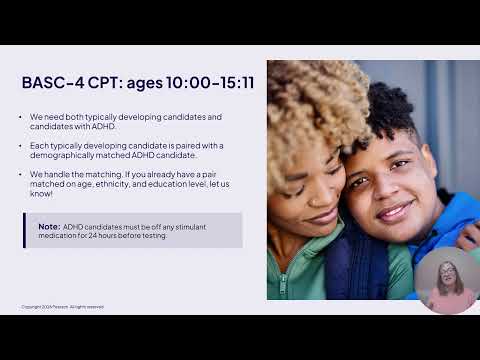
Typically developing: ages 10–15 years
Clinical groups: ages 10–15 years
- Attention-deficit/hyperactivity disorder (ADHD)
Test Administration
BASC-4 CPT
- The CPT must be completed on a computer. No tablets or phones are allowed.
- The CPT will be administered in person. You must remain present with the examinee during completion of the CPT.
- The CPT must be administered with a stable internet connection. Public Wi-Fi may result in data loss because of multiple connections.
- The CPT must be administered in one session without interruptions. Pop-ups may result in data loss.
BASC-4 Forms
- The BASC-4 Self-Report Form is launched digitally from the Assignments tab of the Field Research Portal. You must remain present with the examinee during completion of the Self-Report Form.
- The BASC-4 Parent Form is launched digitally from the Assignments tab of the Field Research Portal to the parent/caregiver.
Required Forms
- A digital Annual Consent Form is required and is launched from the Candidate Profile tab of the Field Research Portal to the candidate/parent.
- A digital Candidate Demographic Form is required and is launched from the Assignments tab of the Field Research Portal to the candidate/parent.
To avoid any delays in payments, ensure that the Annual Consent Form and Candidate Demographic Form are completed and submitted for each candidate before testing.
Become familiar with and bookmark this page. This is the go-to place for BASC-4 CPT standardization information and updates.
Before You Begin
- Review candidates within your Field Research Portal account and ensure that those who are unavailable are marked as such in their candidate profile.
- Complete the required training and receive a passing score on the mandatory quiz*.
- Read the BASC-4 Continuous Performance Test (CPT) Administration Guide
- Review the CPT Administration Demo Video.
- Print the CPT Administration Instruction Cards. If you are unable to print the instruction cards, you will need an alternative electronic device (e.g., second computer, tablet) to review the cards with the examinee.
*The mandatory quiz is only provided to those examiners with selected candidates.
After Receiving Your First Assignment
- Review the assignment requirements within the Assignments tab of the Field Research Portal.
- Launch and receive the required parent/guardian Annual Consent Form before scheduling testing.
- Launch the BASC-4 CPT Candidate Demographic Form to the parent/guardian from the Assignments tab of the Field Research Portal. This is required for each candidate.
A mismatch between the information entered in the candidate profile and the Candidate Demographic Form could result in a test being unusable. Be thorough and verify that all information entered in the Field Research Portal is accurate and specific to that candidate.
During the Data Collection
- Review assignment due dates in the Field Research Portal. The due date is the day Pearson should receive the completed assignment.
- Request an extension if you are unable to submit the test before the due date by leaving a comment in the Assignments tab of the Field Research Portal or by emailing FRExaminerSupport@pearson.com.
- Decline your assignment in the Field Research Portal if you are unable to complete the assignment or if your candidate is no longer available.
Required Training and First Test Review
Training
Examiners must complete training and receive a passing score on a mandatory quiz before BASC-4 CPT assignments are released.
Training will take approximately 1 hour (total video and quiz). Examiners will be paid $100 for training once they have passed the quiz with a 13/13 score. Additional directions can be found in the initial training email.
- BASC-4 CPT Examiner Training Video: Please watch the training video in its entirety and thoroughly review the BASC-4 CPT Administration manual before proceeding to the training quiz.
- BASC-4 CPT Materials: Please become familiar with the BASC-4 CPT materials available on the Examiner Hub. Carefully review and download the BASC-4 CPT Administration Manual, CPT Administration Demo Video, and CPT Instruction Cards. Please note that there will not be a shipped test kit for this project.
- BASC-4 CPT Training Quiz: The training quiz is only available to Examiners with confirmed BASC-4 CPT candidates and assignments. Once your candidate(s) and assignment have been confirmed, you will receive an email with your initial training instructions and a link to the quiz. Please do not complete the training video until you have received this email.
Please add 2 to 5 test candidates to your Portal for our review to be considered for participation. If you have any questions, please contact us at FRExaminerSupport@pearson.com.
 Play
Play
Privacy and cookies
By viewing this third-party content from www.youtube.com, you agree to their terms and conditions, privacy notice and acknowledge they may use cookies and pixels for information and analytics gathering.
| Training Pay | Completion Time | Examiner Pay |
|---|---|---|
| BASC-4 CPT Training | 1 hour | $100 |
First Test Review
Examiners are required to wait for feedback and approval to continue testing after submitting their first test.
- Do not test any other candidates until you have received feedback from Pearson’s Content Development Team (ContentDevFeedback@Pearson.com).
- Feedback is generally provided via email 4–5 business days from when the test is received by Pearson, but may vary.
Test Order: Examiners must follow the administration order specified in each candidate's assignment requirements. Candidates may be assigned to either the standard order (BASC-4 CPT first, then BASC-4 Self-Report) or the counterbalance order (BASC-4 Self-Report first, then BASC-4 CPT). If your first assigned candidate is part of the counterbalance study, you should administer the BASC-4 Self-Report first and then the BASC-4 CPT as directed. Approval is required after your first completed BASC-4 CPT administration, regardless of whether the CPT is administered first or second in the assigned sequence.
Examinees will be paid digitally. The examinee will indicate on the Candidate Demographic Form whether to receive payment via text or email. Payment will be withheld if the Candidate Demographic Form and Annual Consent Form are not completed before testing. The Candidate Demographic Form must be completed by the parent/guardian of a child candidate and must include a phone number or email unique to the participant.
Examinee payments will be sent directly to the candidate or candidate’s parent/guardian. Examiners are not permitted to receive or distribute payments on behalf of candidates. Please review the Examinee Digital Gift Card FAQs.
| BASC-4 CPT standardization | Age | Administration time in minutes* | Examiner pay | Examinee pay | Parent/guardian pay |
|---|---|---|---|---|---|
| BASC-4 CPT | 10–15 | 55 | $100 | $50 | – |
| BASC-4: Self-Rating Form | 10–15 | 60 | $75 | $40 | – |
| BASC-4: Parent Rating Form | 10–15 | 50 | $25 | – | $40 |
*Administration time is the average time expected to complete the evaluation including building rapport and allowing breaks. This can fluctuate depending on the caregiver’s/candidate’s attention level and/or clinical needs.
Typically Developing Candidate Criteria
Inclusion Criteria
To be included in the typically developing study group, a candidate must:
- be ages 10 to 15.
- be able to take a computerized test in a standard fashion.
- be able to read at approximately a third-grade reading level; no formal test of reading ability is required.
Siblings are eligible to participate if they do not fall within the same targeted age band (i.e., 10–11 years, 12–13 years, 14–15 years).
Parent/Caregiver Requirements
The parent or caregiver:
- Must be able to read at approximately a sixth-grade reading level; no formal test of reading ability is required
- May complete up to three forms.
Attention-Deficit/Hyperactivity Disorder (ADHD)
To be included in the ADHD study group, a candidate must:
- be ages 10 to 15.
- have been diagnosed by a qualified mental health professional.
- be able to take a computerized test in a standard fashion.
- be able to read at approximately a third-grade reading level; no formal test of reading ability is required.
- If prescribed stimulant medication for ADHD symptoms, be off medication for at least 24 hours prior to testing.
The candidate must not meet any exclusion criteria as outlined in the BASC-4 CPT Typically Developing Candidate Criteria on the Examiner Hub except those related to a clinical diagnosis as described.
Candidates may have any presentation of ADHD, including Combined Presentation or Predominantly Inattentive Presentation.
Important Project Information
We are in a critical phase and need your help to collect the remaining data for the BASC-4 Narrowband Evaluation Study. We are actively seeking candidates who meet the following criteria:
- Ages 5 to 18
- Currently undergoing an initial evaluation or reevaluation for autism spectrum disorder or a behavioral or emotional disorder.
Only the Clinical Rating Form will be required for the evaluation study.
If you have access to candidates meeting the listed criteria above, please email as soon as possible to FRExaminerSupport@pearson.com.
Qualified Examiners and Candidates
Examiners will be selected based on their profession, and candidates will be assigned based on project inclusion criteria and demographic needs.
Qualified Professions
- Clinical psychologists
- Clinical social workers
- Educational diagnosticians
- Neuropsychologists
- School psychologists
- Psychiatrists
- Psychometrists
Candidates Needed
Clinical study
Candidates ages 5:0–18:11 years undergoing an initial evaluation or reevaluation for ASD or a behavioral or emotional disorder.
Test Administration
- Digital: The Clinician Rating Form will be in a digital format launched from the Assignments tab of the Field Research Portal.
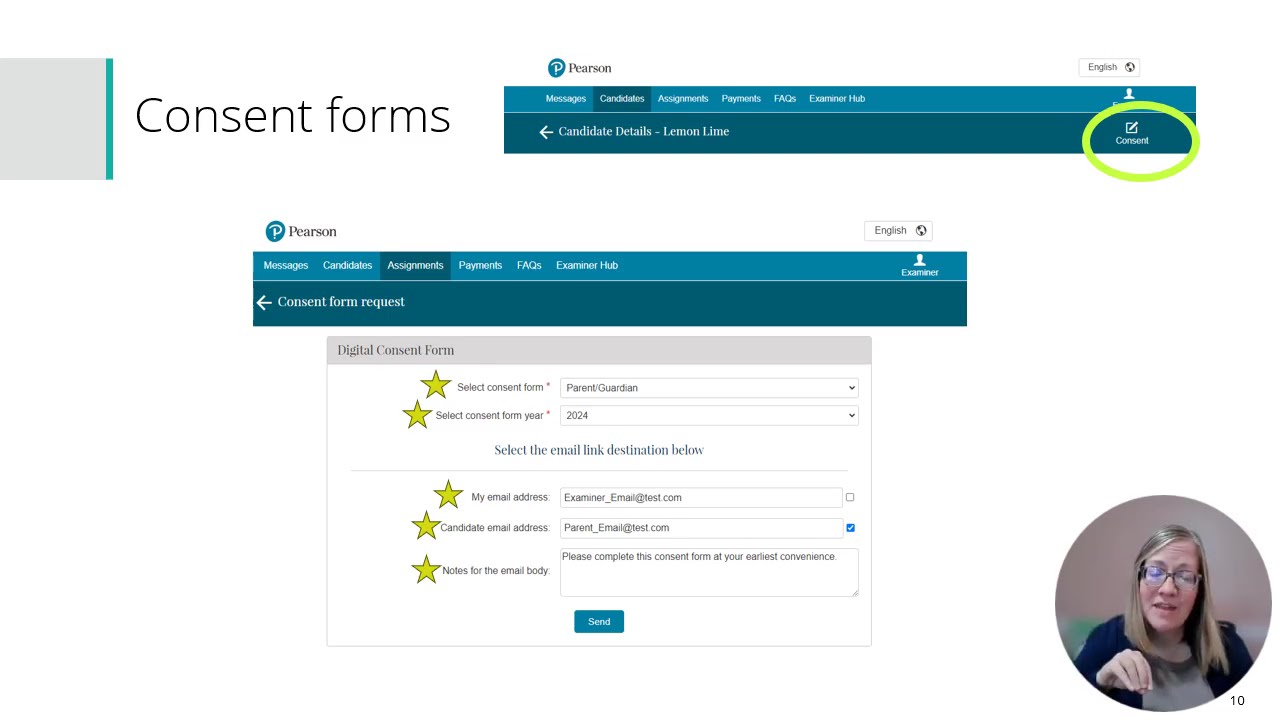
- A digital consent form is required and is launched from the Candidate Profile tab of the Field Research Portal to the candidate/parent.
- A digital candidate demographic form is required and is launched from the Assignments tab of the Field Research Portal to the candidate/parent.
To avoid any delays in payments, please ensure that the consent form and candidate demographic form are completed and submitted for each candidate before testing.
Become familiar with and bookmark this page. This is the go-to place for BASC-4 Narrowband collection information and updates.
Before You Begin
- Add candidates for the BASC-4 Narrowband Evaluation Study and email the field research team at FRExaminerSupport@pearson.com.
- Complete the required training and receive a passing score on the mandatory quiz.
After Receiving Your First Assignment
- Review the assignment requirements within the Assignments tab of the Field Research Portal.
- Launch and receive the required Annual Consent Form before scheduling testing.
- Launch the BASC-4 standardization Candidate Demographic Form from the Assignments tab of the Field Research Portal. This is required for each candidate.
A mismatch between the information entered in the Field Research Portal and the Candidate Demographic Form could result in a test being unusable. Be thorough and verify that all information entered in the Field Research Portal is accurate.
During Data Collection
- Review assignment due dates in the Field Research Portal. The due date is the day Field Research should receive the completed assignment.
- Request an extension if you are unable to complete tests before the due date by leaving a comment in the Assignments tab of the Field Research Portal or by emailing FRExaminerSupport@pearson.com.
- Decline your assignment in the Field Research Portal if you are unable to complete the assignment or if your candidate is no longer available.
Training
Examiners must complete training and receive a passing score on a mandatory quiz before BASC-4 assignments are released.
Training will take approximately 1 hour. Examiners will be paid $125 for training once they have passed the quiz with a 25/25 score.
- BASC-4 Examiner Training Video: Please thoroughly review the BASC-4 Administration Guidelines. Additional directions can be found in the initial training email.
- BASC-4 Training Quiz: The link to the quiz will be provided to Examiners invited to participate in the BASC-4 Examiner training. The quiz link can be found in the initial training email.
 Play
Play
Privacy and cookies
By viewing this third-party content from www.youtube.com, you agree to their terms and conditions, privacy notice and acknowledge they may use cookies and pixels for information and analytics gathering.
| Training Pay |
Completion Time | Examiner Pay |
|---|---|---|
| BASC-4 Training | 1 hour | $125 |
If you have any questions, please email the Examiner Relations team at FRExaminerSupport@pearson.com or call us at 800-233-5686 Monday through Friday from 8 a.m. to 5 p.m. (CT).
Examinees will be paid digitally. The parent/guardian of a child candidate will complete and indicate on the Candidate Demographic Form whether to receive payment via text or email. Examiners are not permitted to receive or distribute payments on behalf of candidates. Please review the Examinee Digital Gift Card FAQs.
Clinician Rating Form: Clinicians who conduct the evaluation will enter their email address on the Clinician Rating Form, and payments will be issued digitally.
Please Note: Examiners who complete the Clinician Rating Form will receive only the standard Examiner payment of $75. The separate clinician payment is available only to an external clinician who conducted the evaluation and is not participating in the project as an examiner.
Remaining clinical study
| BASC-4 standardization clinical | Age (years) | Admin time (minutes) | Examiner pay | Examinee pay | Clinician pay |
|---|---|---|---|---|---|
| BASC-4 Narrowband evaluation study: Clinician Rating Form | 5–18 | 30 | $75 | $20 | $50 |
If you have candidates entered in your Field Research Portal who meet the criteria below, please email us at FRExaminerSupport@pearson.com.
BASC-4 Narrowband Evaluation Study
- Ages 5 to 18
- Currently undergoing an initial evaluation or reevaluation for autism spectrum disorder or a behavioral or emotional disorder.
The clinician who conducted the evaluation will complete a Clinician Rating Form documenting the evaluation outcome and any diagnoses identified during the assessment.
- General Recruiting Toolkit
- BASCpack Collateral
- BASC-4 Information Sheet
- BASC-4 Flyers
- BASC-4 Social Media Post
- BASC-4 Parent Letters
- BASC-4 Parent Letter – The Importance of Teacher Participation
- BASC-4 Admin Letter
- BASC-4 Teacher Letter
- BASC-4 Parent Video – The Importance of Teacher Participation
- BASC-4 Teacher Video – Participating in the BASC-4 Standardization
Examiner Newsletter
Catch up on the latest news and project updates.
Updates
Current Projects
- Wechsler Intelligence Scale for Children | Sixth Edition Standardization (WISC-6)
- Vineland Adaptive Behavior Scales | Fourth Edition Pilot
- BASC-4 Continuous Performance Test (CPT)
- Behavior Assessment System for Children (BASC) | Fourth Edition Narrowband Forms
Coming Soon
- Preschool Language Scales | 6th Edition Pilot (PLS-6)
- Kaufman Test of Educational Achievement | Fourth Edition (KTEA-4 Pilot)