
Blog

  • Assessment for Learning: A Whole Child Approach to Teaching

    by

    Illustration of open book with people and mountain scene on top of it.

    Assessments of learning are a vital part of the learning process. Without tools like tests and quizzes to measure student progress, teachers’ ability to understand where students are instructionally during the course of a school year is severely diminished.

    What if teachers had an assessment tool that allowed them to evaluate student progress while a student is learning, and to inform their teaching practices and family communication going forward? This is known as assessment for learning.

    Effective classroom assessments show how a student is doing, but an “assessment for learning” approach helps identify ways for teachers and parents to point a student in the right direction to succeed.

    According to Jeffrey Hauger, Director of Educator Engagement, incorporating assessment for learning tools provides a comprehensive and cohesive system that is well aligned to instruction and takes the whole child into consideration — not just their academic knowledge.

    “It goes beyond the progress check,” Hauger explains. “It answers the question of ‘what now?’ after educators get assessment results. It incorporates universal screeners and the social-emotional learning components that impact achievement. Once you are asking 'what now?' you are looking at components of learning that help teachers get to where they want to be instructionally."

    Looking beyond academics

    How would a system combining both assessment of learning and assessment for learning work in your school or district?

    Hauger gives the example of an elementary school classroom where a teacher needs to evaluate reading comprehension. A traditional progress check shows if students are performing at grade level, while assessment for learning tools like universal screeners dig a bit deeper to identify possible causes of a reading deficit.

    "A universal screener is a little more in depth than an interim assessment that's measuring all the standards,” Hauger explains. “If the student scored low in reading, the screener would pick that up. That would be something the teacher would want to look at and perhaps provide the student with more opportunities to work on reading comprehension."

    Hauger recommends adding assessments for learning to an overall evaluation to help teachers and school districts close equity gaps for at-risk students.

    "We know the academic components of learning, but there are also the social-emotional aspects," Hauger continues. "It’s important to use assessments that explain what issues the student is facing that could be preventing them from reaching their academic potential. Assessments for learning really help show where more targeted supports for the student can help."

    Seeing the full narrative

    With time already at a premium, assessments for learning can be difficult for overscheduled teachers to consider, but effective assessment platforms will incorporate them into comprehensive toolkits that enable a whole-child approach. These toolkits allow teachers to build an overall growth model with individualized pictures of how students are progressing and why, as well as ways to improve.

    "If you have a system that considers the different pieces, then the results give you a narrative and you don't have to fill in the puzzle to analyze it," Hauger says. "It will show you these are all related, so you can easily see the student's weaknesses and strengths."

    For example, if during an online assessment the system recognizes a third-grade student isn’t at grade level, modern platforms can adapt questions to meet the student where they are in their learning and notify the teacher about precisely where the gaps are.

    Another advantage of incorporating assessment for learning into a comprehensive system is that it results in better communication with parents and caregivers. "You can use technology to explain in layman’s terms what these reports are telling you about your student," Hauger adds.

    "More importantly, these days you can send results in multiple languages which leads to more parent engagement. Effective platforms help districts get information out to parents so they have a better understanding of how their student is doing.”

    Greater insights into “what now?”

    Hauger believes that as more districts activate the assessment for learning tools in the online platforms they use, they will be amazed by the increased insights they have at those "what now?" moments.

    "You'll see more and more of this comprehensive approach that uses different information to look at students — not only on the level of academic standards,” he explains. “They’re going to have confidence in personalized approaches that meet students where they are. Assessment for learning drives insights about the whole student, and it does it when it’s timely so teachers can use that insight to adjust and connect with their students."

    Ready to elevate your assessment strategy? Let’s connect.  

    Read more
  • Pearson Acquires Navvy Education’s Innovative Classroom Assessment System

    by

    Illustration of people watching sunrise

    Navigate the learning journey with confidence!

    The disruption in student learning caused by COVID-19 and the ongoing challenges faced by schools and districts have inspired us to double down on our commitment to provide classroom assessments that offer more useful and reliable information to students, families, and educators.

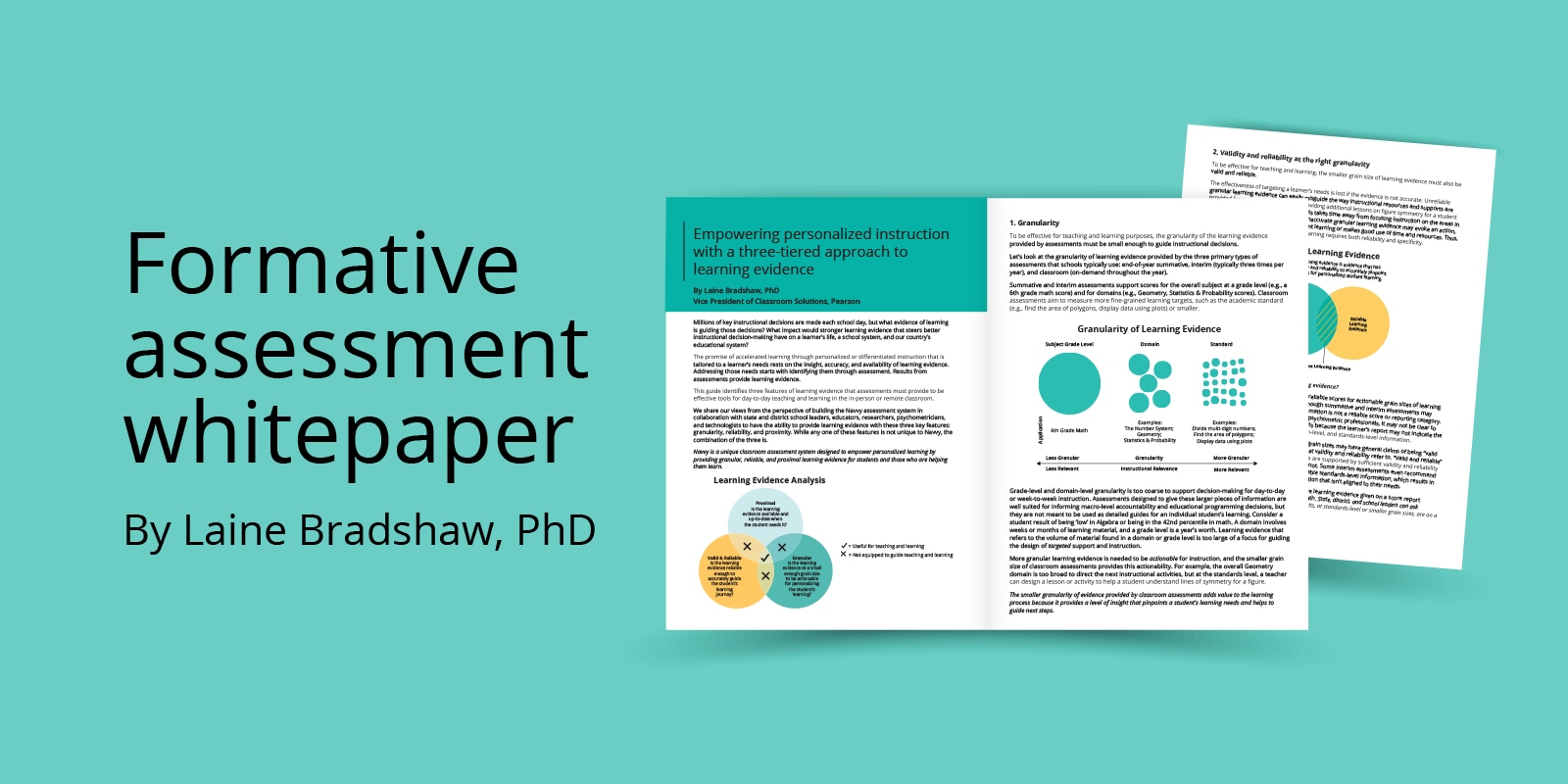
    One significant step we’ve taken is the acquisition of Navvy Education which includes a diagnostic classroom assessment system that uses a unique design to pinpoint student needs on individual standards. Navvy’s technology is helping teachers and students navigate learning by providing an accurate, detailed, and real-time picture of student progress. Its reporting furnishes actionable data not provided by typical formative, interim, or summative assessments.

    Save time and guide learning with accurate results.

    In short, Navvy’s design gives teachers the ability to assess students for standard competencies right after instruction rather than weeks (or even months) later. Student results reflect their “Competency/Needs Support” status for individual academic standards, allowing the teacher to tailor instruction for the students who need further learning before moving on to the next concept.

    Classroom formative assessment is a key component of a balanced assessment system, providing information that guides teachers in their planning. However, the quality of teacher decisions is only as good as the quality of the assessment data from which those decisions are based. This is where Navvy is different. Navvy includes rigorous assessment content, a unique assessment design, and a sophisticated psychometric model for improved reliability and utility of results.

    Navvy’s design is based on three key principles:

    • Results must be accurate
    • Results must be actionable
    • Results must be immediate

    Founded in 2017 by Dr. Laine Bradshaw, Navvy was created by Dr. Bradshaw and her team in close collaboration with educators and district leaders. Navvy’s innovative approach is supported by Dr. Bradshaw’s research as an associate professor of Quantitative Methodology in Educational Psychology at the University of Georgia.

    “We designed Navvy to provide a new approach to assessment that informs personalized learning in the classroom on a regular basis. We’re excited to continue and expand this work as a part of Pearson. As we reimagine the important role assessments play in a learner’s academic journey, we’ve moved away from traditional accountability measures and are focusing on the student to promote healthy learning mindsets and provide educators with the data-driven tools needed to accelerate learning.”

        – Dr. Laine Bradshaw, Founder of Navvy

    By marrying the technical quality of Navvy’s assessment system with Pearson’s longstanding ability to deliver assessments to millions of students, we are ready to provide states and districts across the nation with a solution that works.

    “As learning experiences continue to evolve, we’re prepared to forge new trails of innovation and meet these new challenges and opportunities. By investing in new and existing services to better assess and communicate about learning progress, we’re also investing in the potential of every student.”

        – Trent Workman, Senior Vice President School Assessments

    This addition to our assessment portfolio has great potential to help K–12 districts make better decisions when instructional time is at a premium and get a full picture of each student’s learning progress. We are excited to join forces with Dr. Bradshaw and her team and to add Navvy’s technology to our leading portfolio of assessment services!
     

    Read more