Kaufman Test of Educational Achievement | Third Edition
KTEA-3
For educational teams who need a broad measure of listening, speaking, reading, writing, and math skills—including two parallel forms, two measures of rapid automatized naming (RAN), story-based Written Expression measurement, and norm-referenced error analysis—the KTEA-3 is an individually administered, norm-referenced assessment for children, adolescents, and young adults. The KTEA-3 is the most current version of the KTEA. See our Guidance on using this assessment remotely.- Publication date:
- 2014
- Age range:
- Individuals 4:0–25:11
- Scores/interpretation:
- Age- and grade-based standard scores (M = 100, SD = 15), age and grade equivalents, percentile ranks, normal curve equivalents (NCEs), stanines, and Growth Scale Value (GSV)
- Qualification level:
- B
- Completion time:
- 15-85 min for ASB Composite
- Administration:
- Q-interactive® (digital) or paper-and-pencil
- Scoring options:
- Q-global® (web-based) or manual scoring
- Report options:
- Q-global® report includes Score Summary, subtest Comparisons, Achievement/Ability Comparisons Error Analysis, and Instructional Interventions
- System requirements:
- Software is compatible with Windows (XP, Vista, 7, 8, 10) and macOS (up to and including High Sierra). The audio files are located on the KTEA-3 USB Flash drive.
- Telepractice:
- Guidance on using this test in your telepractice.
Empower all your students to succeed and receive a deeper understanding of achievement gaps with the new KTEA-3.
Benefits
- Evaluate academic skills in reading, math, written language, and oral language.
- Measure progress or response to intervention and identify learning disabilities, and adjust instruction based on performance.
- Identify learning disabilities and achievement gaps.
- Motivate low-functioning students using novel tasks.
- Covers IDEA and National Council of Teachers of Mathematics (NCTM).
Features
KTEA-3 maintains all the important features of the KTEA-II with a wealth of new updates:
- Dyslexia Index Scores for screenings, research, and inclusion in an assessment battery.
- New subtests including Writing Fluency, Silent Reading Fluency, Math Fluency and Reading Vocabulary.
- New norms for ages 4:0 through 25:11 and for grades pre-K through 12.
- Mapping to Common Core Standards to assist with compliance issues.
- Behavioral checklist and intervention suggestions for parents and teachers.
Subtests
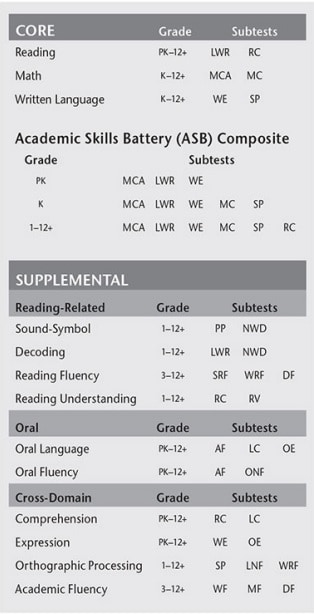
- Phonological Processing (PP)
- Math Concepts & Applications (MCA)
- Letter & Word Recognition (LWR)
- Math Computation (MC)
- Nonsense Word Decoding (NWD)
- Writing Fluency (WF)
- Silent Reading Fluency (SRF)
- Math Fluency (MF)
- Reading Comprehension (RC)
- Written Expression (WE)
- Associational Fluency (AF)
- Spelling (SP)
- Object Naming Facility (ONF)
- Reading Vocabulary (RV)
- Letter Naming Facility (LNF)
- Listening Comprehension (LC)
- Word Recognition Fluency (WRF)
- Oral Expression (OE)
- Decoding Fluency (DF)
If you are taking a test in Q-global and are having difficulty hearing the audio (from the USB flash drive), please follow these steps:
- Place the audio files in a folder on your hard drive
- Right-click on the file you want to play
- Select "Play with Windows Media Player"
- You can now select all the files in the file folder and follow the same steps if you need to easily click through the different tracks
Note: If this solution does not solve the problem, please contact our technical support department by phone for more assistance at 1-800-627-7271
Resource Links
- Meet the Kaufman Family
- “COVID Slide” Not Evident in Individually Administered Clinical Test Scores Obtained From a Large, Referred Sample
- Why a Flash Drive?
- Intervention Guide for LD Subtypes
- Case Study
- Pearson Clinical Assessment Solutions: A Dyslexia Toolkit
- Case Study: The Importance of Multiple Measures in Psychoeducational Evaluation
- Digital Stimulus Assets Flyer
- KTEA-3 Technical Report: Error Analysis for Out of Level Item Sets
- Dyslexia Index Scores Flyer
- Podcast: Introduction to Special Issue and to KTEA-3 Error Analysis
- Error Analysis Article
- Analysis of Student Errors in Reading, Writing, and Math: Implications for Assessment and Intervention
- KTEA-3 Decision Tree
Sample Reports
KTEA-3 on Q-interactive at a Glance:
Available With
- Standard, Academic, Classroom, & Experiential Licenses
Subtest Pricing
Scoring and Reporting
- Score Report
Materials Needed
- View the Pricing & Ordering tab and Q-interactive page
Benefits of KTEA-3 on Q-interactive
- Access the full complement of KTEA-3 subtests with the tap of a button.
- Create custom batteries by combining subtests from the KTEA-3 with ability measures such as the WISC-V.
- Engage children by displaying stimuli on the iPad
- Standardize administration with automated basal and ceiling rules.
- Automatically generate score reports, including ability-achievement discrepancy and patterns of strengths and weaknesses analyses with the WISC-V and other cognitive tests.
- Obtain scaled scores immediately after finishing a subtest, to increase speed and accuracy.
- Save time by having item analysis automatically calculated by the system.
How Can I Buy KTEA-3 on Q-interactive?
New customers:
Annual Q-interactive licenses can be purchased using our online order form or by calling Customer Support at 1-800-627-7271. See the Q-interactive pricing tab for more information on license options.
Current Q-interactive customers:
If you want to add the KTEA-3 to your account, visit our online order form and select the "Add test(s) to existing account" option. You may also call Customer Support at 1-800-627-7271.
The following training events are available for KTEA-3.