Sensory Profile 2
The Sensory Profile™ 2 family of assessments provides standardized tools to help evaluate a child's sensory processing patterns in the context of home, school, and community-based activities. Guidance on using this test in your telepractice.- Publication date:
- 2014
- Age range:
- Birth–14:11
- Scores/interpretation:
-
Q-global (web-based) or manual scoring
- Qualification level:
- B
- Completion time:
- 5–20 minutes
- Administration:
- Paper-and-pencil or online administration
- Other languages:
- Spanish
- Telepractice:
- Guidance on using this test in your telepractice

The Sensory Profile 2 quickly assesses and organizes examinee information, generates scores, and produces accurate, comprehensive reports. These significantly revised questionnaires provide caregivers and teachers with deeper insight to help customize the next steps of intervention.
Benefits
- Make theory-based decisions leveraging principles of neuroscience, sensory processing, strengths-based approaches, and ecological models embedded in the items and scoring structure.
- Identify and document how sensory processing may be contributing to or interfering with a child's participation at home, school, and the community.
- Contribute valuable information to a comprehensive assessment of the child's sensory strengths and challenges in context.
- Develop effective treatment plans, interventions, and everyday remediation strategies.
Features
Using paper-and-pencil or online administration, caregivers and teachers report on the child's response to sensory events throughout the day.
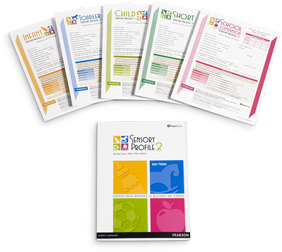
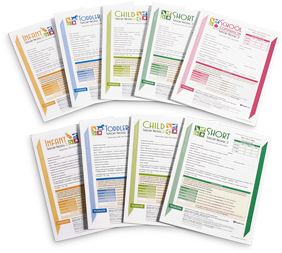
- Combined questionnaire and score forms: Infant, Toddler, Child, Short, and School Companion forms in one manual.
- Spanish versions of the Caregiver Forms.
- Expanded age range: Child, Short, and School Companion forms age increased to 14:11 to give more flexibility in assessing preteens and younger teens.
- Shorter questionnaires: Infant, Child, School Companion, and Short form questionnaires are briefer. The toddler questionnaire is increased by just a few items, reflecting new understanding of sensory processing at this age.
- Updated content and greater item consistency between forms.
- Cut scores with optional percentiles for an additional level of analysis.
- A wide range of studies between children with and without disabilities, to ensure discrimination with vulnerable populations.
Sample Reports
Each form includes some combination of Sensory System, Behavioral, Sensory Pattern, and School Factor scores. The Assessment and Planning Report links findings form the questionnaires to participation at home, in school, and in the community. The Multi-rater report facilitates sensory processing assessment in context.
Get Sensory Profile training!
Are you new to using Sensory Profile? Perhaps you’ve been using it for a while and need some guidance on getting the most out of it. Either way, this new training is for you! We've taken the most frequently asked questions about interpreting the Sensory Profile and created a training module that teaches you a system and structure for understanding the test scores and using them to inform your clinical reasoning. It includes an overview of Dunn's sensory processing framework, on which test scores are based, and explains how clinicians can translate theory to practice by interpreting test data in light of participation strengths and challenges. The importance of addressing sensory processing differences within the context of occupational performance will be highlighted in case studies. Two on-demand training sessions are available. One offers 0.3 AOTA CEs and one does not offer CEs. Please review the item descriptions to choose the session you'd prefer.
At the end of the training, you will be able to:
- Analyze the meaning of different score patterns within the context of everyday life
- Interpret Sensory Profile test data to identify the impact of sensory processing patterns on participation – in terms of both strengths and challenges
- Use the Sensory Profile data to drive evidence-based intervention planning
To purchase, select from the training options above this tab.
The following resources are available for Sensory Profile 2.
Overview Materials
Author Case Study Series
This 3-part webinar series by Sensory Profile 2 by author Dr. Winnie Dunn uses case study examples to support health and education professionals to incorporate sensory processing knowledge into everyday practice. This series has been provided with the support of Occupational Therapy Australia and is reproduced here with the permission of Occupational Therapy Australia.
Case Study 1
Using the Toddler Sensory Profile 2 to support a 2 1/2 year old whose family are requesting help with hygiene and meal-times.
Case Study 2
Using the Child Sensory Profile 2 to support a 5 year old who lives in a rural location and needs to be able to participate in car journeys with her family.
Case Study 3
Using the School-Companion Sensory Profile 2 to support a child in third grade who is becoming more socially isolated.
Select a question below to see the response.

Related Items