Movement Assessment Battery for Children, Third Edition
MABC-3
The Movement Assessment Battery for Children - Third Edition (Movement ABC-3) provides an objective measurement of gross and fine motor coordination difficulties in children and young adults aged 3-25 years.Now available- Publication date:
- Winter 2023
- Age range:
- 3 to 25 years
- Scores/interpretation:
- Task-level scaled scores, domain-level t-scores. Total Motor Score, percentile ranks
- Qualification level:
- B
- Administration:
- Individual; paper and pencil or digital via Q-global
- Scoring options:
- Hand scoring or digital scoring via Q-global
- Report options:
- Score summary report
- Norms:
- The Movement ABC-3 norms are based on all-new sample of over 1000 children and young adults who were tested between August 2021 and February 2023 in the UK, Australia and New Zealand.
The Movement Assessment Battery for Children–Third Edition (Movement ABC-3) provides an objective measurement of gross and fine motor coordination difficulties in children and young adults aged 3 – 25 years.
Movement ABC-3 Benefits:
- Identify delay or impairment in motor development
- Plan intervention
- Measure change and monitor progress over time
- Widely known and respected for use in research related to motor development
- Gain a holistic picture of motor performance using the Checklists to complement observational assessment
The Movement ABC-3 updates include:
- Revised and updated test content and items
- New manipulatives
- Extended age range down to 3 and up to 25
- Co-collected sample between the UK and ANZ
- Unified constructs across ages
The Movement ABC-3 has three subtests:
- Manual Dexterity
- Aiming & Catching
- Balance & Locomotion
There are also separate Checklists for each age band:
- Parent/Teacher/Other
- Self (age band 3 only)
Component benefits:
- Identify delay or impairment in motor development
- Plan intervention
- Measure change and monitor progress over time
- Widely known and respected for use in research related to motor development
- Gain a holistic picture of motor performance using the Checklists to complement observational assessment
Component features:
- Norms based on a sample of 1279 collected jointly in the United Kingdom, Australia and New Zealand
- Extensive international research built over the previous version of the assessment and this version - featuring in over 500 studies
- Numerous translations worldwide
Test content and structure
The test contains 10 tasks for each of 3 age ranges: 3 – 6 years (3-year-olds complete 7 tasks); 7 – 11 years and 12 – 25 years. The tasks cover the following 3 domains:
- Manual Dexterity
- Aiming & Catching (ball skills)
- Balance & Locomotion
Task, domain, and Total Motor scores are provided. A profile of a child’s performance over the different sections of the test can be examined and a ‘traffic light’ system helps map areas of strength and concern.
The assessment is paralleled by an observational approach to perceptual-motor aspects and emotional and motivational difficulties the individual may have in relation to motor tasks.
The Movement ABC-3 Checklists
The Movement ABC-3 Checklists provide a means for assessing movement in everyday situations in which the child or young adult participates.
Use the Checklist to:
- Assess groups of students in classroom situations
- Obtain parents’ or teachers’ views on an individual’s movement in everyday settings
- Measure the extent to which a young person’s attitudes and feelings about motor tasks are situation specific or more generalized
- Ascertain the impact of motor difficulties on an individual’s participation in everyday activities
Digital administration and scoring options
The Movement ABC-3 Test is administered using paper record forms. The Movement ABC-3 Checklist can be administered using either paper or digital administration. Online scoring is available via Pearson’s Q-global® online assessment platform.
-
For the following items:
Age Band 1: Balance & Locomotion 2 – Walking Heels Raised
Age Band 2: Balance & Locomotion 2 – Walking Heel-to-Toe Forwards
Age Band 3: Balance & Locomotion 2 – Walking Toe-to Heel BackwardsIf the examinee reaches the end of the line without error, circle “Yes” on the record form and assign the examinee a raw score of 15 (i.e. the maximum score). Assign the maximum score of 15 even if the examinee has taken more or less than 15 steps to successfully complete the line.
This is the same scoring approach used in Movement ABC-2. -
The items in the plastic bag are dividers to help you organize your kit bag if you wish. There is also a storage bag for the walking line mats. They aren't required for any of the assessment tasks - you can discard them if you don't want to use them.
-
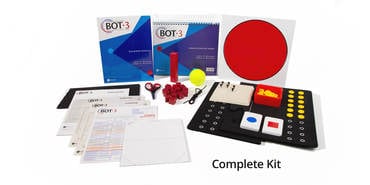
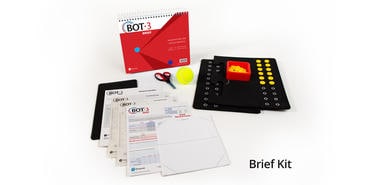
The tennis ball, bean bag, pegboard and pegs, yellow threading beads, lacing board, triangle test, blue coin bank and coins have all been carried over from the previous edition. New manipulatives that have been introduced in the Movement ABC-3 kit include a larger ball, updated balance board and mats, new target, line walking mats and two additional sets of threading beads for age bands 2 and 3.
-
Some of the manipulatives are the same in the 2nd and 3rd editions of the test, but the majority of items in the Movement ABC-3 are new, for example the Test manual, Checklist manual, record forms, Checklists, drawing circles sheets, and the additional or updated manipulatives. It is therefore not recommended to try to upgrade an old kit. Manipulatives that have been carried over from the Movement ABC-2 can be kept as spare parts.
-
For Q-global users, a link to the videos is available in a pdf document in the Q-global resource library. Test users who don't have access to Q-global may use the Movement ABC-3 demonstration videos reference sheet.
-
During standardization, the Movement ABC-3 research team asked that two Checklists were completed for each examinee by people who knew them well, but they did not stipulate the relationship between the examinee and the respondents. Due to the variety of respondent types the numbers in some categories were not large enough to develop reliable norms for any group beyond the primary respondent for each Age Band. Therefore, cut offs are provided from the following primary respondents:
- Age Band 1: parents
- Age Band 2: parents
- Age Band 3: self-reports
Complimentary assessment overviews and training
Learn more about MABC-3 and how to use it with fidelity.
Whether you’ve purchased this assessment or need additional information to help make your purchase decision, we’ve got complimentary on-demand, introductory training to help guide you.
Register for Brainshark to access the brief assessment overview, including a description of the components, types of scores provided, and applicable clinical populations.
New Brainshark users |
Existing Brainshark users |
Next Steps
Once you are logged in*, you will find the complimentary training in the Content Portal. If you do not see the Complimentary Training group, contact Customer Support at +1 (800) 627-7271 or email clinicalcustomersupport@pearson.com and we will add it to your profile.
*If you are a new registrant, you will receive an email with the subject line, “Your Brainshark Username and Password” from noreplies@brainshark.com. This email will contain your username and temporary password. You will be prompted to reset your password when you log in for the first time.
The following training events are available for MABC-3.
Related Items