
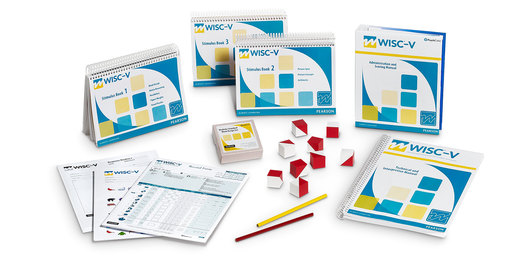
Wechsler Intelligence Scale for Children | Fifth Edition
WISC-V
Wechsler Intelligence Scale for Children® Fifth Edition (WISC®-V) is an intelligence test that measures a child’s intellectual ability and 5 cognitive domains that impact performance. Guidance on using this test in your telepractice.- Publication date:
- 2014
- Age range:
- Children aged 6:0–16:11
- Scores/interpretation:
- FSIQ, Primary Index Scores and Ancillary Index Scores
- Qualification level:
- C
- Completion time:
- Core subtests: ~60 minutes
- Administration:
- Paper-and-pencil or digital
- Scoring options:
- Q-interactive® Administration and Scoring, Q-global® Scoring & Reporting or Manual Scoring
- Telepractice:
- Guidance on using this test in your telepractice.

The WISC-V gives school psychologists, clinical psychologists and neuropsychologists flexibility and interpretive power to get a broader view of a child's cognitive abilities.
Benefits
- Increase construct coverage without increasing test time.
- Identify and diagnose intellectual and learning disabilities.
- Evaluate cognitive processing strengths and weaknesses.
- Assess giftedness and the impact of brain injuries.
- Significantly reduce testing time to obtain FSIQ.
- Supports more flexible evaluation of specific learning disabilities and two major approaches to specific learning disability identification: (1) pattern of strengths and weaknesses analyses and (2) ability-achievement discrepancy analyses.
Features
WISC-V delivers more flexibility, more content and more interpretive power.
- Three new primary subtests — Visual Puzzles, Figure Weights, and Picture Span — measure the ability to analyze and synthesize information, quantitative reasoning and induction, and visual working memory.
- Five new complementary subtests assess cognitive processes important to academic achievement in reading, math, and writing.
- Simplified instructions with reduced vocabulary level, shorter discontinue rules and refined scoring criteria.
- Full scoring reports and interpretive reports include narrative interpretation scores.
- Separate visual spatial and fluid reasoning composite scores results in greater interpretive clarity.
- Statistical links to two measures of academic achievement: KTEA-3 and WIAT-III.
- Normative sample standardized on 2,200 children aged 6:0–16:11.
Scales
Sample Reports
Score reports automatically convert total raw scores to subtest scaled scores and sums of scaled scores to composite scores, including the FSIQ and numerous index scores. Interpretive reports include narrative interpretation of scores.
Technical Reports & Materials
- “COVID Slide” Not Evident in Individually Administered Clinical Test Scores Obtained From a Large, Referred Sample
- WISC-V Technical Report 1: Expanded Index Scores
- WISC-V Technical Report 2: Testing Children Who Are Deaf or Hard of Hearing
- WISC-V Technical Report 3: Using the WASI-II with the WISC-V
- WISC-V Technical Report 4: WISC-V Special Group Study: Children with Hearing Differences Who Utilize Spoken Language and Have Assistive Technology
- WISC-V Technical Report 5: Expanded General Ability Index
- WISC-V Technical Report 6: Extended Norms
- Q-interactive Technical Report 8: Equivalence of Q-interactive and Paper Administrations of Cognitive Tasks: WISC-V
- Q-interactive Special Group Studies: The WISC-V and Children with Intellectual Giftedness and Intellectual Disability
- Q-interactive Special Group Studies: The WISC-V and Children with Autism Spectrum Disorder and Accompanying Language Impairment or Attention Deficit/Hyperactivitiy Disorder
- WISC-V Coding and Symbol Search in Digital Format: Reliability, Validity, Special Group Studies, and Interpretation
- WISC-V Technical Report 13: Children with Specific Learning Disorders in Reading or Mathematics
Resource Books
There are three books for purchase that provide in-depth information about WISC-V.
- Essentials of WISC-V Integrated Assessment | Buy the Book
- WISC-V Assessment and Interpretation | Buy the Book
- Intelligent Testing with the WISC-V | Buy the Book
- Essentials of WISC-V Assessment | Buy the Book
Benefits of WISC-V on Q-interactive
- Access the full complement of WISC-V subtests with the tap of a button.
- Create custom batteries by combining subtests from the WISC-V and other tests such as the WIAT-III.
- Engage children by displaying stimuli on the iPad.
- Standardize administration and simplify the management of WISC-V materials so you can focus on what is important – the examinee.
- Automatically generate score reports, including ability-achievement discrepancy and patterns of strengths and weaknesses analyses with the WIAT-III and KTEA-3.
- Obtain scaled scores immediately after finishing a subtest, to increase speed and accuracy.
How Can I Buy WISC-V on Q-interactive?
New customers:
Annual Q-interactive licenses can be purchased using our online order form or by calling Customer Support at 1-800-627-7271. See the Q-interactive pricing tab for more information on license options.
Current Q-interactive customers:
If you want to add the WISC-V to your account, visit our online order form and select the "Add test(s) to existing account" option. You may also call Customer Support at 1-800-627-7271.
Select a question below to see the response.
Test Framework, Revision Goals, and General Practice Issues
Changes in the test structure include new and separate Visual Spatial and Fluid Reasoning index scores and new measures of visual spatial ability, quantitative fluid reasoning, visual working memory, rapid automatized naming/naming facility, and visual-verbal associative memory. To augment the primary index scores and the FSIQ, a number of new ancillary and complementary index scores are also available, such as quantitative reasoning, auditory working memory, naming speed, symbol translation (i.e., visual-verbal associative memory), and storage and retrieval index scores. The changes were influenced by contemporary structural models of intelligence, neurodevelopmental theory and neurocognitive research, clinical utility and factor-analytic studies.
The separation of Visual Spatial and Fluid Reasoning index scores results in greater interpretive clarity. The addition of visual working memory enhances the scale's clinical utility due to domain-specific differentiation of working memory abilities. The new naming facility and visual-verbal associative memory measures are related to achievement and sensitive to specific learning disabilities and a wide variety of other clinical conditions. These measures are useful in a pattern of strengths and weaknesses approach to specific learning disability identification.
Theory was not the only consideration that influenced the development of the WISC–V, and no single theory determined its structure. Neurodevelopmental research and clinical utility were also important considerations when determining the WISC–V test structure. However, the WISC–V model reflects contemporary structural intelligence theories, such as CHC, and defensible theoretical perspectives and frameworks, including CHC theory, can be utilized in its interpretation.
Widely accepted structural intelligence models based on factor analytic results, such as CHC theory, provide overwhelming evidence for general intelligence at the top of a hierarchical model and for various related and distinguishable broad abilities at the level beneath. In some models, the specific abilities are each composed of various narrow abilities at the lowest level. Although evidence from structural models does not identically converge, most indicate that verbal comprehension, visual spatial, fluid reasoning, working memory, and processing speed abilities are among the important components, and these are the five primary index scores available for the WISC–V. The names of these factors vary, based on the taxonomy system used by a team of investigators; the CHC taxonomy provides names for these constructs (i.e., Gc, Gv, Gf, Gsm, and Gs, respectively). The Wechsler intelligence scales have evolved in response to these consistently observed factors, and the WISC–V continues this work by providing new measures of working memory and a new working memory composite, offering separate visual spatial and fluid reasoning composites, and improving upon the measure of verbal comprehension and processing speed while continuing to offer composite scores for each. The WISC–V also includes a storage and retrieval index (SRI) that is analogous to Glr in the CHC taxonomy. When used together with an achievement measure, such as the WIAT–III or the KTEA–3, a number of other constructs are also measured, including aspects of auditory processing (i.e., Ga) within CHC theory.
Yes. Substantial efforts were made during development to achieve the shortest testing time possible and still offer greater construct coverage and flexibility. As a result, administration time is shorter than that of the WISC–IV. For the heart of the test, the primary index scores, the subtests take less time (about 10 minutes) to administer than the WISC–IV. The FSIQ can be obtained about 25–30 minutes faster than the WISC–IV. Because administration time is determined by the composite scores desired, it varies based on the practitioner's choices. The WISC–V measures a number of other related constructs (e.g., rapid automatized naming, visual-verbal associative memory). If you opt to administer the measures related to these constructs, the testing time will somewhat longer.
As shown in Table 3.6 of the WISC–V Technical and Interpretive Manual, representative proportions of children from the special group studies were included in the normative sample. In addition to children with various clinical conditions, children with intellectual giftedness also were included to appropriately represent children with extremely high scores. The proportions of children from special group studies are low, and accurately reflect their presence in the U.S. population. It is unlikely the inclusion of very small proportions of children with disabilities in the normative sample will result in more children scoring within the normal range.
Because the age ranges of the WISC–V and the WAIS–IV overlap for examinees aged 16, practitioners have the option of choosing the appropriate measure for an examinee this age. For examinees suspected of below average cognitive ability, the WISC–V should be administered because of its lower floor at this age range. For examinees of high ability, however, the WAIS–IV should be considered because of its higher ceiling. For the examinee of average ability, the choice between the WISC–V and the WAIS–IV requires clinical judgment from the educational and/or psychological professional. Both tests require the administration of 10 subtests to calculate the FSIQ and primary index scores, but examinees who have difficulty completing a lengthier assessment may benefit if the WISC–V is used because it is somewhat faster to obtain the primary index scores and the FSIQ. The WISC–V provides a Nonverbal Index that requires no expressive responses, which may be useful for examinees who are English language learners or who have expressive difficulties. The WISC–V provides some additional composite scores and more links to achievement tests that may be informative for certain referral questions (e.g., specific learning disability). The reasons for referral, familiarity with the tests, and knowledge of the examinee's characteristics (e.g., attention span) should be taken into consideration.
The FSIQ is generally the first choice for an ability-achievement discrepancy analysis, because it provides the broadest sample of behavior. However, there may be other circumstances that influence your choice (e.g., significant discrepancies between index scores when a language disorder is suspected). In these situations, other scores might be appropriate (i.e., VCI, VSI, FRI, GAI, NVI).
Yes, the WIAT–III and the KTEA–3 scoring reports on the Q-globalTM platform can be used to evaluate a specific learning disability, using a pattern of strengths and weaknesses discrepancy analysis approach. The data are too complex to provide in a paper format; the scoring software must be used for this purpose.
- When the child responds incorrectly to a teaching item, teaching is provided regardless of the start point used or the child's age.
In early research phases of the project, data were collected with extended time limits. Analyses indicated the children who answered correctly after the time limit were of lower ability than children who answered before the time limit. There was often little benefit to extending the time, as few children could answer correctly after the time limit expired. Data were not collected with extended time limits at standardization because that would've given children more exposure to the items which could result in some additional procedural learning or practice that is not standard. Process observations to test the limits can be done at the end of all testing and described qualitatively in the report.
Figure Weights Process Approach and Arithmetic Process Approach will be offered with the WISC–V Integrated, which is due out in late 2015. Those are standardized subtests that offer additional time for items that were missed.
Every discrepancy that appears on the Record Form is described in chapter 6 of the WISC–V Technical and Interpretive Manual.
Color-blindness occurs in approximately 10% of the general population, and more commonly in males. We have made every effort to ensure our items, including those on the WISC–V, WPPSI–IV, WASI–II, WAIS–IV, WISC–IV, WPPSI–III, and WASI, are free of bias against these individuals. Items are reviewed by color-blindness experts as well as individuals with color-blindness during early stages of test development. In addition, acetate overlays have been utilized to give the test developers a visual representation of the stimuli as it appears to individuals with the various types of color-blindness. Items are also copied in greyscale to check appearance to those with monochromatic color-blindness. All items are also subjected to a color-blindness simulation to check item appearance with every type of color-blindness and to ensure that the intensity and saturation of colors are not overly similar and do not suggest different responses.
Extended norms are used by practitioners who are evaluating intellectually gifted children, to inform interpretation. Extended norms must be validated with a sample of children who are highly intellectually gifted, and that case collection takes some time because these children are rare. The validation sample is currently being collected. The WISC–V was released at the end of September, 2014, and the extended norms are planned for release approximately a year and a half after the initial release of the WISC–V.
Assumptions make a difference in an investigator's approach to data. This debate in intelligence testing on profile analysis dates back to the 1990s. Some authors criticize methods of interpretation that focused on identifying the examinee's relative strengths and weaknesses (relative to the examinee's own ability, whether high or low). Others claim that only the index scores should be interpreted and that FSIQ is just a summary of different abilities that should not be interpreted if there are discrepancies among the index scores.
The first group assumes that only g is important, and not broad cognitive abilities like crystallized intelligence, fluid reasoning, and working memory. Accordingly, they statistically remove g from the index scores and examine only the index scores' residual validity. They then conclude that the modest portions of variance attributed to the first order factors (the index scores) is too small to be of importance, and that the FSIQ is the only score worth interpreting.
This approach is problematic because an individual's investment of g resources in particular directions results in greater development of those abilities over time. Thus, removing the influence of g from the index scores effectively cripples their power, and creates a rather artificial situation. As Schneider (2013) observed,
“…the independent portion is not the ‘real Gc'. We care about a sprinter's ability to run quickly, not residual sprinting speed after accounting for general athleticism. So it is with Gc: g is a part of the mix” (p. 188).
The second group argues that the FSIQ is meaningless because it is merely a grouping of various abilities and should not be interpreted. Their work similarly disregards or dismisses g in analyses.
This topic is characterized by considerable variability of opinion: The first group argues that interpretation of index scores is invalid and recommends interpreting only FSIQ, while the second group argues that interpretation of FSIQ is invalid and recommends interpreting only the index scores. Either view excludes important information and is too one-sided. Both g and the broad abilities are important, and each construct has a place in the practice of assessment.
Schneider, W. J. (2013). What if we took our models seriously? Estimating latent scores in individuals. Journal of Psychoeducational Assessment, 31, 186–201.
Subtests
Yes, many of the subtests have demonstration, sample, and teaching items built in to ensure the child understands the task. These items were added in response to the needs of thousands of children who participated in the development of the scale. Children with special needs were included among these participants.
In the online basic training that is included with each kit, we describe in more detail the types of analyses that were conducted to make the decisions regarding which subtests would be primary and which would be secondary. To summarize, the team looked at psychometric properties such as floors, ceilings, reliability, validity, and construct coverage; clinical utility; demographic differences; user-friendliness; and feedback from practitioners and customers. There is nothing that precludes administration of secondary subtests if a practitioner believes that useful information will be gathered for a particular child.
- Word Reasoning was removed because of its construct overlap with Vocabulary, its lack of strong validity evidence as a fluid reasoning measure, and its high correlation with the Information subtest, which rendered it somewhat redundant psychometrically.
- If the time limits are removed, children who do not have the commensurate intellectual ability complete more items correctly. Removing the time bonuses on this subtest would result in a loss of the ceiling, greatly reduced reliability, and a much lower correlation with general intelligence. These issues greatly reduce the meaningfulness of scores that could be derived from the results. For practitioners who are interested in a score without time bonuses, a Block Design No Time Bonus (BDn) process score is available and can be compared with Block Design.
- Picture Completion was removed to decrease the emphasis on speed in the battery and to allow measurement of other constructs of interest (e.g., visual spatial ability, fluid reasoning, visual working memory, rapid automatized naming, visual-verbal associative memory).
- Whether Block Design is appropriate depends on the severity of the motor impairment. Unless the child has severe motor impairment, they may be able to complete the task. You will need to evaluate the severity and impact of the motor impairment for each case. If Block Design cannot be administered, the Visual Puzzles subtest can be substituted to obtain the FSIQ. The VSI and some ancillary index scores may not be obtained in this situation.
It would be inappropriate to interpret Arithmetic as a measure of only Fluid Reasoning or only Working Memory. That is why it does not contribute to any primary index score. Arithmetic hasn't changed—it measures what it has always measured. What has changed is the clarity with which it is understood. The visual-spatial emphasis of the PRI obscured Arithmetic's strong relationship with the fluid reasoning component of that scale. The new test structure means that Arithmetic may be more useful for hypothesis testing than as an indicator of a broad ability. Arithmetic has always been a highly g-loaded and factorially-complex subtest.
Confirmatory factor analysis proceeds from theory. Based upon current theory, a 5-factor model, with Arithmetic loading on the Fluid Reasoning factor, was tested and provided a better fit. The factor loadings shift somewhat due to the new WISC–V subtests. The confirmatory factor analysis in the WISC–V Technical and Interpretive Manual demonstrates that models with Arithmetic loading on the Working Memory factor also had merit and provided a good fit. There is a new visual working memory subtest in the WISC–V, whereas all of the Working Memory subtests in prior versions were verbally presented. This may account for some portion of the shift, because Arithmetic is also verbally presented. When more fluid reasoning and visual spatial subtests and the new visual working memory subtest were present, the PRI split into the Visual Spatial factor and the Fluid Reasoning factor.
WISC–V Arithmetic has a substantial cross loading on the Working Memory factor, but it has a slightly higher loading on the Fluid Reasoning factor. It also has a cross loading on the Verbal Comprehension factor. Neurocognitive research shows that fluid reasoning and working memory both involve the prefrontal cortex. Furthermore, a great deal of empirical literature supports that they are related abilities.
With the new classification, interpretation at the subtest level could be presented in a more nuanced manner, rather than conceptualizing Arithmetic as a pure measure of a single ability. The WMI is intended to provide information about working memory ability, but the WISC–V subtests are thought to measure a number of different aspects of cognitive ability; they are not pure measures of the abilities represented by the factors on which they fall. Interpretation may vary depending on the particular examinee and will be nuanced based on the relationship among measures, response processes, and clinical information. For example, if the examinee has significant language problems, you are likely to see lowered scores on Arithmetic because of the impact of language comprehension on the test. If the examinee has significant deficits with math operations, that is, a math disability or low ability on measures of math computation, then low Arithmetic scores are likely associated with that problem. If the examinee has intact language and computational skills, low scores may be due to quantitative reasoning, that is, they don't know how to solve math problems or how to figure out what steps or what calculations are needed. In these circumstances, Figure Weights could provide more information. As another example, if the patient has low working memory ability, then Arithmetic will be low because of problems manipulating information in working memory. Digit Span Backward and Digit Span Sequencing or Letter–Number Sequencing could provide some information to support this hypothesis.
A number of articles have been published showing that the WISC–IV may be interpreted with the new 5-factor model, and Flanagan and Kaufman's Essentials of WISC–IV Assessment has several chapters that cover the interpretation of the Wechsler intelligence scales from this perspective.
- As part of any revision, items that may require revision are identified for various reasons (e.g., length of time in use, cultural shifts, wording, vocabulary level, relevance). There have been modifications to the Comprehension items to make them not only culturally relevant, but also more child-friendly. For example, more questions related to child-relevant content appear on the WISC–V, and no item contains the word “Advantages” any longer.
Check to ensure you are in the NSQ column in the norms table in the WISC–V Administration and Scoring Manual Supplement. Some examiners mistakenly apply the column from the NSco, NSsco, or NSln process scores to their NSQ results and obtain unusually high scores as a result.
Out of level norms are not provided, because the construct being measured by the task is changed if the child does not know the words. Do not administer this item if the child does not know letters and numbers. For children aged 7–8, it is still possible to obtain a process score on WISC–V Naming Speed Size-Color-Object without Naming Speed Letter-Number. WISC–V Naming Speed Quantity may also be administered in this situation, but the Naming Speed Index and the Storage and Retrieval Index cannot be obtained. For children aged 9–16 who do not know the names of letters or numbers, another object- or shape-naming task (e.g., from KTEA–3 or NEPSY–II) could be used as well.
Individuals with color-perception differences are a group that encompasses greater than 10% of the general population. These issues are much more common in males. We have made every effort to ensure our items, including those on the WAIS–IV, WISC–V, WPPSI–IV, and WASI-II, are free of bias against these individuals. Items are reviewed by color-perception differences experts, as well as individuals with color-perception differences, during the early stages of the test development process. In addition, acetate overlays have been utilized so that the test developers can understand the appearance of the stimuli to individuals with various color-perception differences. Items are also copied in black and white to check appearance to those with monochromatic color perception. All items are also subjected to an electronic “color-blindness” simulator to check item appearance with every type of color-perception difference and ensure that the intensity and saturation of colors are not confused or result in different responses. For the WISC–V, the colors are yellow, blue, and red; green is not included. This means that for the most common color blindness (green/red, which is 7%-10% of boys), the children will be able to take it without a problem. Children with monochromacity (0.00001% of children) should not be administered the WISC–V Naming Speed Literacy items that involve colors; however, they could take Item 3 (Letter–Number) and the Naming Speed Quantity subtest For children with deuteranopia (1%), the simulation, template, and expert review indicate that they should be able to see the differences between the yellow and blue.
- Only the last trial administered is counted.
- Yes.
- Count the blocks that are in the correct position, but not the ones involved in the dimension error.
- The NSL score is converted on the top right corner of the Ancillary and Complementary Analysis page using the Total Raw Score to Standard Score Conversion table. Refer to Steps 3–4 on pages 70–71 of the WISC–V Administration and Scoring Manual.
- In this situation continue providing the prompt until the child complies. The sample items provide ample opportunity for the child to practice until he or she is accustomed to finger tracking.
“Which 3 pieces do you mean?” See the sixth bullet on page 170 of the WISC–V Administration and Scoring Manual.
- Yes, the median is correct. The median for age 16 is 9. The 50th percentile is midway between scores of 8 and 10, so the median is correctly calculated by dividing the difference. This slight age-based decrease across some ages occurs because the LPSr is calculated based on the last item with a perfect score. There are some later items that have fewer response options relative to the earlier ones; hence there is a decrease in the measures of central tendency. The LPSr score should be reported alongside LPSs for context.
Check to be sure that you are looking at the correct column in Table C.6 of the WISC–V Administration and Scoring Manual Supplement. These ages have process scores for NSsco and NSln, and the columns are between the NSL and NSQ columns. Using the incorrect column can result in erroneous, abnormally high scores on NSQ.
The demonstration and the sample item are used together to teach how the task and items are completed. The "on top of" direction is to teach the child not to stack the pieces on top of each other in layers to complete it, but that the pieces have to fit next to each other. In the demonstration item you are actually teaching the child what "next to" means when you show them the correct response, because there is one piece that is above another. The child also get additional feedback during the sample item explicitly if he or she is stacking the pieces "on top of" each other to get a solution.
If, after you show them on the demonstration item that choosing those three answers constitute "next to," and the child asks what "on top of" means, it's fine to explain more using the demonstration and the sample item. The demonstration item would be a perfect place to emphasize this point. Page 47 of the WISC–V Administration and Scoring Manual states that demonstration and sample items are used to explain the task and allow the child to practice.
No. The WISC–V was standardized with the same general 30-second guideline as all subtests without strict time limits (e.g., Similarities, Vocabulary, Digit Span). There is no stopwatch necessary. If an examinee has failed more than a couple of the previous items and demonstrated that he/she is at the edge of his/her ability level, give the prompt asking if he/she has an answer. However, if the examinee has passed the previous items and there is a good chance that he/she might get the current item correct, the examinee should be allow more time to work on the item.
Some research phases have involved timing responses with a stopwatch and not using a 30-second guideline. This research suggested that after about 30 seconds, examinees very seldom respond correctly. More than 30 seconds can be given though; this is not a hard and fast rule. Use your judgment about when it is appropriate to move to the next item, balancing rapport and opportunity. Don't allow an examinee to contemplate an item for several minutes. Prompt the examinee and then move to the next item by saying, "let's try another one," or some other general transitional statement (see chapter 2 of the Administration and Scoring Manual).
Queries in general are used to elicit additional information when a child’s response is incomplete, vague, or unclear. For example, if a child’s response is unclear, you can request clarification by saying, What do you mean?, Tell me more about it, or some other neutral inquiry. Queries are included in the Item Administration section of relevant subtests in Chapter 3. The use of a query is typically indicated by recording a Q next to the written verbatim response on the Record Form. Select items with sample responses that require a specific query are noted with an asterisk (*) on the Record Form and in this manual. Provide the specific query as indicated.
Composite Scores
Composite scores are often described in qualitative terms according to the examinee’s level of performance relative to same-age peers. The descriptors are useful for clear communication of results to individuals who are unfamiliar with quantitative test results. Qualitative descriptors are only suggestions and are not evidence-based; alternate terms may be used as appropriate.
The WISC–V FSIQ and the WISC–IV FSIQ differ in some respects. The WISC–V FSIQ is based on seven subtests: Similarities, Vocabulary, Block Design, Matrix Reasoning, Figure Weights, Digit Span, and Coding. Compared with the WISC–IV FSIQ, the WISC–V FSIQ assigns a relatively lighter weight to working memory and processing speed abilities, as only one subtest from each of these domains are included. Therefore, somewhat less emphasis is placed on working memory and processing speed.
The FSIQ is usually considered the score that is most representative of general intellectual functioning (g). The primary index scores (e.g., VCI, VSI, WMI) represent intellectual functioning in specified cognitive areas (e.g., verbal comprehension, visual-spatial ability, working memory). The FSIQ is derived from a subset of the subtests that contribute to each primary index score.
Research suggests that even when a cognitive ability composite score, such as the FSIQ, is based on disparate abilities, it still has predictive validity. Best practice suggests that you conduct a complete discrepancy analysis (looking at statistical and clinical significance of strengths and weaknesses) and conduct additional assessments (e.g., adaptive behavior, social and emotional functioning) to fully understand a child's needs. There may be times where there are such statistically and clinically significant discrepancies in a child's profile that the FSIQ does not represent a unitary construct; however, this does not render the score invalid. Rather, the FSIQ may not tell you everything that you need to know to plan appropriately for a child. In most cases, abundant information regarding treatment needs can be gained from the various primary and ancillary index scores (and other information) available. You will also need to consider the child's culture, language, and background and to consult your local guidelines for eligibility in making a determination.
The FRI measures the child's ability to detect the underlying conceptual relationship among visual objects and to use reasoning to identify and apply rules. Identification and application of conceptual relationships in the FRI requires inductive and quantitative reasoning, broad visual intelligence, simultaneous processing, and abstract thinking. The subtest composition of the FRI differs from the WISC–IV PRI. Matrix Reasoning is the only common subtest, contributing to the FRI as well as the WISC–IV PRI. Block Design and Picture Concepts, which contributed to the WISC–IV PRI, are not included. Figure Weights, a new subtest on WISC–V, contributes to the FRI. Compared with the WISC–IV PRI, the WISC–V FRI emphasizes abstract conceptual reasoning more and construction abilities requiring visual-perceptual integration and visual-spatial reasoning less.
Contemporary research indicates that working memory is an essential component of other higher-order cognitive processes. The WMI measures the child's ability to register, maintain, and manipulate visual and auditory information in conscious awareness. Registration requires attention, auditory and visual discrimination, and concentration. Maintenance is the process by which information is kept active in conscious awareness, using the phonological loop or visual sketchpad. Manipulation is mental resequencing of information based on the application of a specific rule. The subtest composition of the WMI differs from the WISC–IV WMI. Digit Span is the only common subtest, contributing to the WMI as well as the WISC–IV WMI. It has been substantially revised for the WISC–V to increase the working memory load by adding a new sequencing condition. Letter–Number Sequencing, which contributed to the WISC–IV WMI, has been replaced with Picture Span, a new visual working memory subtest in WISC–V. Compared with the WISC–IV WMI, the WISC–V WMI emphasizes visual working memory more and auditory working memory less.
The 13 index scores available on the WISC–V can be subdivided into three categories: primary, ancillary, and complementary. The five primary index scores are derived from administration of the 10 primary subtests, supported by factor analysis, and theoretically and clinically driven. They are recommended for a comprehensive evaluation of cognitive ability that includes the Verbal Comprehension Index, Visual Spatial Index, Fluid Reasoning Index, Working Memory Index, and Processing Speed Index. The ancillary index scores, includingthe Quantitative Reasoning Index, Auditory Working Memory Index, Nonverbal Index, General Ability Index, and Cognitive Proficiency Index, are derived from combinations of primary subtests or primary and secondary subtests, and they provide additional information regarding a child's cognitive abilities and WISC–V performance. The complementary index scores are the Naming Speed Index, Symbol Translation Index, and Storage and Retrieval Index. They are derived from administration of the complementary subtests, and provide further information about other cognitive abilities that may be assessed if the clinical need is present. These tasks were developed to enhance the assessment of children with suspected learning disabilities and are not designed as measures of intellectual ability.
The ancillary and complementary index scores are described below.
Ancillary Index Scores
Quantitative Reasoning Index (QRI) – The QRI is derived from the sum of scaled scores for the Figure Weights and Arithmetic subtests, and is an indicator of the child's quantitative reasoning skills.
Nonverbal Index (NVI) – Offers an estimate of overall ability for children using subtests that do not require any verbal responses. Due to the relatively reduced verbal demands of its contributing subtests, the NVI may offer a more appropriate estimate of overall ability than the FSIQ for children with expressive issues or with clinical conditions associated with expressive language issues (e.g., autism spectrum disorders) or who are English language learners.
General Ability Index (GAI) – Provides an estimate of general ability that is less reliant on working memory and processing speed compared with the FSIQ.
Cognitive Proficiency Index (CPI) – Provides an estimate of the efficiency with which cognitive information is processed in the service of learning, problem solving, and higher order reasoning.
Complementary Index Scores
Naming Speed Index (NSI) – Provides a broad estimate of the automaticity of basic naming ability, drawn from a variety of tasks.
Symbol Translation Index (STI) – provides a broad estimate of visual-verbal associative memory, drawn from a variety of conditions.
Storage and Retrieval Index (SRI) – provides a broad estimate of long-term storage and retrieval accuracy and fluency, derived from a variety of tasks designed to measure cognitive processes that are associated with reading, mathematics, and writing skills, and have shown sensitivity to specific learning disorders and other clinical conditions.
The NVI may be especially useful in these types of situations. Refer to the special group studies in Chapter 5 and to the appropriate interpretive section in Chapter 6 of the WISC–V Technical and Interpretive Manual for more information. Ability-achievement discrepancy analyses, using the NVI with the WIAT–III and the KTEA–3, can be conducted using the tables in Appendix B of the WISC–V Technical and Interpretive Manual.
The GAI provides an estimate of general intellectual ability that is less impacted by working memory and processing speed than the FSIQ. Children with neurodevelopmental disorders associated with difficulties in working memory and processing speed, such as learning disabilities, ADHD, Language Disorder, or autism spectrum disorder, may obtain lower FSIQ scores than children without such difficulties. In these situations, the lower FSIQ score may mask meaningful differences between general cognitive ability (represented by the FSIQ) and other cognitive functions (e.g., achievement, memory, and specific neuropsychological functions). The GAI was developed to help practitioners with the identification of relative strengths and weaknesses that are based on comparisons between general ability and other cognitive functions. Compared with the FSIQ, the GAI provides the practitioner with an estimate of general intellectual ability that is less sensitive to the influence of working memory and processing speed by excluding those subtests. The FSIQ can be compared to the GAI to assess the effects of a weakness in cognitive proficiency (as measured by the working memory and processing speed subtests) on the child's overall cognitive functioning. In some situations, it may be appropriate to use the GAI for score comparisons with measures of achievement or other cognitive functions. An evaluation of the significance and frequency of GAI–FSIQ differences may inform decisions about when to use the GAI in specific clinical situations.
There is not an analogous table that reports these data by special group. Table C.11 in the WISC–V Administration and Scoring Manual Supplement reports this information by total sample and by ability level. One portion of this table reports the information for children with GAI ≥ 120.
No. Because this procedure estimates performance on a primary subtest using a secondary subtest, the results should be interpreted with caution and considered non-standard.
A maximum of one substitution may be made when deriving the FSIQ only. No substitutions can be made for any other composite score. The potential FSIQ substitutions are limited in order to constrain additional measurement error that may be introduced by this practice. Table 2.8 in the WISC–V Administration and Scoring Manual indicates allowable substitutions for deriving the FSIQ.
Because substituted subtests are being used as an estimate of performance on another subtest, only secondary subtests within the same cognitive domain that are highly related to the primary subtest can be substituted.
No. When deriving the FSIQ, you can only substitute a secondary subtest for a primary subtest that is spoiled or invalidated, or for a specific clinical purpose. Secondary subtests can also provide additional information on cognitive functioning. If you need to substitute a secondary subtest in place of a primary subtest for deriving the FSIQ, it is best practice to decide this before you administer the subtest—not after you have derived scaled scores. Secondary subtests are also useful when the primary subtest scores that contribute to a primary index score are widely discrepant. In this situation, additional information from secondary subtests can help to shed light on factors that may contribute to such disparate results.
Because subtest substitution may introduce measurement error into derived composite scores, substitution is limited. The index scores are derived from fewer subtests than the FSIQ, therefore, the risk of such error is greater. If a secondary subtest substitutes for a primary subtest for the FSIQ, the Q-globalTM scoring software will not allow calculation of the primary index score that the primary subtest contributes to.
Prorating is available for the FSIQ only. A maximum of one proration or substitution may be made when deriving the FSIQ. Proration and substitution may not be combined to derive an FSIQ.
The NSI is not an average of NSL and NSQ, it's a sum of standard scores. Having low scores on both components (i.e., NSL and NSQ) leads to an even lower NSI because in the distribution, having low scores on both is rarer than having a low score on one subtest and an average score on the second subtest. If you are familiar with the statistical phenomenon of regression to the mean, then this will make sense. If not, think about an Olympic gymnast competing in the all-around. It is rare to see someone score a perfect 10 on every event. It is more common to see them score a perfect 10 on one event and 8s on the others. The same applies to low scores. There is a tendency for subsequent observations to be less extreme.
Some interpretive approaches posit that composite or index scores are less valid or less reliable if their component parts are discrepant. In these interpretive approaches, the Full Scale IQ or an index score is described as valid, reliable, and interpretable only if no significant discrepancy exists between the highest and lowest primary index scores. Similarly, the index scores are only described as valid and reliable if their contributing subtests are not significantly discrepant. There does not exist evidence that there is a discrepancy or index score scatter beyond which the Full Scale IQ becomes invalid, unreliable, and uninterpretable. When great variability or discrepancy characterizes the primary index scores or the subtest scaled scores, the Full Scale IQ alone is insufficient to describe a child's intellectual abilities (obviously a lot more description would help). Reliance on any single score is never recommended for describing a child's intellectual abilities or for identifying his or her strengths and needs. Also, not all of the subtests that contribute to index scores are always used to create the FSIQ; the FSIQ is derived from a subset of those primary subtests...see especially WPPSI–IV and WISC–V.
Recent research indicates that the Full Scale IQ has equal construct and predictive validity regardless of primary index score discrepancies. The construct and predictive validity of the Full Scale IQ is independent of the discrepancy (Daniel, 2007). Similarly, the construct and predictive validity of the primary index scores is independent of the amount of discrepancy between subtests (Daniel, 2009). Furthermore, it is quite typical to have a discrepancy of greater than 1.5 SDs (23 points or more) between two primary index scores. In fact, 56.6% of the normative sample (that is, 1,246 of the 2,200 children) had such a discrepancy. Similarly, 52.5% of special group study cases (261 of the 497 children from these groups) had such a discrepancy. Given the vast evidence in support of the predictive validity of g and Full Scale IQ (Daniel, 2007; Deary & Johnson, 2010; Deary, Strand, Smith, & Fernandes, 2007; Johnson, Deary, & Iacono, 2009; S. B. Kaufman et al., 2012) it is counterintuitive to assume that for almost 60% of children the Full Scale IQ is not valid. Moreover, because more specific domains of intellectual ability do not show the same broad degree of predictive validity as does g (Gottfredson, 2008; Hartmann, Larsen, & Nyborg, 2009; Kotz, Watkins, & McDermott, 2008; Reeve & Charles, 2008), the Full Scale IQ provides essential, clinically rich information when attempting to understand the expression of intelligent behavior in real world settings (Jacobson, Delis, Hamilton, Bondi, & Salmon, 2004).
With respect to the Full Scale IQ's reliability in the presence of relatively large discrepancies among primary index scores, there is no evidence that the Full Scale IQ becomes unreliable in these circumstances either (some people feel intuitively that it does). For example, Table 4.3 of the WISC–V Technical and Interpretive Manual lists the subtest reliability coefficients for special groups. For the special groups with larger scatter among primary index scores, the subtest reliabilities are comparable with those of other special groups with smaller scatter among primary index scores (e.g., Intellectual Disability-Mild). Because these coefficients are comparable with those of the normative sample, it is more likely that the Full Scale IQ reliability for special samples would be similar to that of the normative sample.
Across a large sample of examinees that were administered the WISC–IV and the WISC–V, small average subtest- and composite-level score differences were present. The data indicate very few individuals obtain larger differences.
A number of issues may contribute to score differences, including:
- Changes in the norms or normative sample (e.g., the Flynn effect, different demographic makeup of the normative sample to match nationwide population-level changes in the intervening period between editions).
- Changes in the mix of constructs measured by scores: New subtests and changes in the weighting of the five major cognitive domains used to derive composite scores may result in some children with particular patterns of cognitive strengths and weaknesses obtaining larger (or smaller) than average differences between tests. For example, a greater proportion of Fluid Reasoning subtests contribute to the FSIQ relative to WISC–IV (28% instead of 20%); therefore, a child with a weakness in fluid reasoning may obtain a lower FSIQ on the WISC–V than on the WISC–IV.
- Changes in the child since the previous testing: When a child is administered the WISC–V a year or more after being tested with the WISC–IV, there are many clinical reasons why he/she may obtain a larger than average difference that have little to do with the test. For example, some children with specific learning disabilities or other neurodevelopmental disorders that interfere with learning and attention may not keep pace with the cognitive development of their peers over time and can fall further behind on measures of cognitive ability as they age.
- Regression to the mean. This is a phenomenon common to all psychological tests where an extreme observation on a test tends to become less extreme the next time the construct is tested.
- Changes in the norms or normative sample (e.g., the Flynn effect, different demographic makeup of the normative sample to match nationwide population-level changes in the intervening period between editions).
Many people find this result counterintuitive, but it is correct. First, consider that the FSIQ is used to predict the student's true intelligence and does not correlate perfectly with it. Then consider that the index scores are composed of fewer subtests than the FSIQ score and do not correlate perfectly with the FSIQ. In this case, if the student's true FSIQ is 57, then his or her index scores should be higher than 57 due to the effect of regression toward the mean. On the other end of the continuum, the opposite is true. If a student's FSIQ is 147, there is a greater probability that his or her index scores will be lower than the FSIQ.
This effect can be found in the composite score norms tables of many tests of cognitive ability, though the strength of the effect depends on several factors, including the number of subtests entering the composite, the distance of the subtest scores from the mean, and the correlation among those subtests.
When a composite is made up of more subtests, the effect is larger. It is rarer to score about 2 standard deviations below the mean on each of the 7 subtests that compose the FSIQ than on each of the two subtests that compose an index score. This is why the effect is more pronounced for the FSIQ than for any of the five index scores.
The further a score is from the mean, the larger the effect. This is because it is rarer to score about 2 standard deviations from the mean on all 10 primary subtests than it is to score 1 standard deviation from the mean all 10 subtests. The effect is usually more pronounced at 2 standard deviations from the mean than at 1 standard deviation from the mean. In the WISC–V, the effect is largest at approximately 2 standard deviations above or below the mean. Beyond this point, the minimum and maximum possible scores constrain the effect.
Think about an Olympic gymnast competing in the all-around. It is rare to see someone score a perfect 10 on every event. It is more common to see them score a perfect 10 on one event and 8's on the others. Great performance on multiple subtests is more rare, so it results in a higher composite score. The result is more unusual.
Kit Materials
The supplement contains all tables needed to fill out the Ancillary and Complementary Analysis and Process Analysis pages of the Record Form. You do not need the supplement during administration. You will only need it during scoring and only if you wish to supplement the primary analysis using these other scores.
Stimulus Books 1 and 2 are necessary when administering the 10 primary subtests. Stimulus Book 3 is necessary when administering the complementary subtests.
The Record Form does not provide designated space to tally or derive process observations or contrast scores because they are not used for every administration or by every practitioner. The Record Form pages associated with each subtest and with summary and analysis were also subject to horizontal and vertical space limitations. These limitations are due to the maximum amount of printed and white space and pages available within a durable, bound paper booklet. There was simply not room to include these optional scores.
Page 50 of the WISC–V Administration and Scoring Manual provides the instructions for recording process observations on the Record Form in undesignated space (i.e., the margins of the Record Form). Page 76 of the manual provides instructions on using the tables in Appendix D of the WISC–V Technical and Interpretive Manual to obtain the normative information for selected process observations for certain subtests.
The Record Form also does not provide space to derive contrast scores. However, Appendix C of the WISC–V Technical and Interpretive Manual contains the necessary directions and tables to derive these scores, as well as the corresponding interpretive information.
Use the smaller of the two numbers because of how cumulative percentages are calculated. Refer to p. 75 of the WISC–V Administration and Scoring Manual.
Q-global Scoring and Reporting
Q-global is a web-based scoring and reporting platform that offers accessibility from any computer connected to the Internet. It allows for quick and automatic organization of examinee information and the ability to generate scores and produce accurate and detailed results. Reports are available in a PDF or WORD document format. Go to http://www.helloq.com to sign up for a Q-global account.
Both the score report and interpretive report are available now on Q-global.
Yes. You can reprint a report at no charge if you change any demographic or report options. However, if you alter raw data, a new record is created and a new report usage is required to print the output.
A drop-down menu within the WISC–V Q-global scoring software facilitates subtest substitution. Choose your substitution in the drop-down menu.
On rare occasions, an inadequate number of valid subtest scores are obtained to derive the FSIQ, despite the availability of secondary subtests. Q-global automatically prorates the FSIQ if a primary subtest that contributes to it is missing and a secondary subtest is not selected for substitution. If more than one primary subtest is missing, the FSIQ is not calculated. Proration is only available for the FSIQ and only when the prorated sum of scaled scores is based on primary subtests. You cannot combine subtest substitution and proration when deriving the FSIQ.
The rules governing allowable substitutions for core subtests for Q-global and hand scoring (i.e., in the WISC–V Administration and Scoring Manual) are the same. Substitution should only be used when the primary subtest is missing or invalid or in certain clinical situations when it is determined that a secondary subtest is a better estimate of the cognitive ability than the primary subtest (e.g., when a child's physical condition interferes with performance). Any substitution selected within Q-global is made on all applicable composites, and any score comparisons that utilize the substituted subtest are affected.
The score comparisons are not available because the data they are based on require the missing subtest. For example, pairwise index-level difference comparisons that include the VCI are not provided in Q-global if Information is substituted for Vocabulary when deriving the FSIQ, because the VCI is not calculated.
Some other comparisons may also be unavailable if substitution is used. For example, index-level strengths and weaknesses comparisons require calculation of the mean primary index score or the FSIQ. If the VCI is unavailable, the MIS cannot be calculated. In this situation, the FSIQ becomes the comparison score, and the other available primary index scores are compared with the FSIQ rather than the MIS.
Yes. It is possible to either manually enter the WISC–V scores when creating a KTEA–3 or a WIAT–III score report or import scores from the WISC–V score report on Q-global.
The report includes two analyses to aid in the identification of specific learning disabilities: the traditional ability-achievement discrepancy analysis and the pattern of strengths and weaknesses discrepancy analysis.
Yes, you may use Q-global on Macs.
With Q-interactive, you are actually administering the test using the tablet devices. The tablets are serving as your stimulus book, and record form for the WISC-V. Data are transferred and stored via best-in-industry standards for security. These precautions help you with HIPPA and FERPA compliance.
When you use Q-global to score the WISC–V, you will still have the paper record form that you will need to store appropriately. Scores would be input into the Q-global system and securely saved there. However, Q-global (for the WISC–V) is only saving raw scores/item score information, not responses as in Q-interactive. Think of Q-global for WISC–V as similar to scoring programs you have used in the past (only this one is web-based with a secure server).
Yes, since Q-global is web-based, you may access it using your username and password from any device that is connected to the internet. There are two pricing options available. In addition to a per-report price, there is also an unlimited-use subscription option (1-, 3-, and 5-year subscriptions). Please visit PearsonClinical.com/WISCV for pricing.
The following training events are available for WISC-V.

Related Items