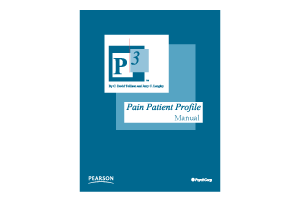
P-3® (Pain Patient Profile)
Authors: C. David Tollison, PhD, and Jerry C. Langley, DC
Quickly evaluate for depression, somatization, and anxiety in pain patients.
The Pain Patient Profile (P-3) assessment focuses
on the factors most frequently associated with chronic pain. The test can
help provide an objective link between the physician's observations and the
possible need for further psychological assessment.
How to Use This Test
A variety of medical professionals, including anesthesiologists, general practitioners,
rehabilitation specialists, chiropractors, surgeons, neurologists, and nurses
can use the P-3 test to help:
- Identify the psychological roadblocks to patient recovery
- Assess, document, and justify the need for further psychological evaluation
- Facilitate physician-psychologist communication
- Evaluate the patient's emotional readiness for surgery
- Support evaluations for cases involving vocational readiness; orthopedic,
occupational, and auto injuries; workers' compensation; and long-term disabilities
- Easily and inexpensively measure pre- and post-treatment pain status to evaluate
treatment effectiveness and monitor clinical outcomes
Key Features
- The test can help save time and money and reduce frustration for both patient
and medical providers by identifying psychological factors that may be preventing
the patient from reaching a successful medical outcome.
- The test report includes an easy-to-understand summary of results to share with the patient.
- Requiring only 12-15 minutes to administer, the test can be easily administered
as part of an initial clinical evaluation.
- The test was normed using both pain patients and subjects from the community. This cross-validating approach helps assure that results are more relevant to pain patients than more traditional assessments may be.
C. David Tollison obtained his PhD in clinical psychology and biological psychology with an emphasis in psychopharmacology from the University of Georgia. He interned at the Medical College of Georgia. Prior to his current position as founder and director of the Greenville (South Carolina) Hospital System Center for Health and Occupational Services, Dr. Tollison was director and president of Pain Therapy Centers, a hospital corporation that developed and managed nine hospital-based pain treatment programs in the eastern and midwestern United States. He is the author of over 30 scientific articles and 12 book chapters on pain diagnosis and treatment. He has also written or edited 9 textbooks. Dr. Tollison serves as associate clinical professor at the Medical College at Georgia and is a visiting professor in the Wyeth-Ayerst Pharmaceutical Laboratories Visiting Professor Program.
Jerry C. Langley graduated from the University of South Carolina in 1974 with a degree in social and behavioral science. He is a 1979 graduate of Life Chiropractic College. Dr. Langley is currently in private practice in Greenville, South Carolina. He contributed a chapter on the use of spinal manipulation in the treatment of low back pain to The Handbook of Chronic Pain Management. Dr. Langley has frequently lectured on the subject of spinal disabilities for the South Carolina Industrial Commission. He recently gave a lecture on spinal manipulation in the treatment of back pain to the American Academy of Pain Management.
DEP—Depression
ANX—Anxiety
SOM—Somatization
VAL—Validity Index
A total of 497 subjects participated in cross-validating the P-3 assessment. Approximately half of the subjects were pain
patients (N=243) and half were community subjects (N=254).
Interpretive Report (Product Number 51527)
The report offers the health professional detailed analysis
of the individual's responses and includes graphic profiles of how the results
compare to the norm group. Raw scores for each of the three scales (Depression,
Anxiety, and Somatization) are transformed into T scores based on a pain patient
normative
sample. These T scores are used to plot the individual's results. The report
is divided into:
- Profile Validity: Describes the extent to which the patient understood the questions, answered randomly or magnified symptoms.
- Results Summary: Narrative explanation of scores.
- Pain Patient Profile: Graphic representation of scores.
- Clinical Interpretation: Narrative explanation of clinical scale scores.
- Treatment Recommendation: General suggestions for the medical practitioner.
- Omitted Items
- Patient Summary: One-page synopsis of the patient's results written in
layman's language that can easily be shared with the patient.
View a sample Interpretive Report.
View a sample annotated Interpretive Report.
Progress Report (Product Number 99999)
The report enables the clinician to monitor a client's progress over time.
View a sample Progress Report.
Q Local Software - Enables you to score assessments, report results, and store and export data on your computer.
Mail-in Scoring Service - Specially designed answer sheets are mailed to us for processing within 24–48 hours of receipt and returned via regular mail.
Hand Scoring - Administer assessments on answer sheets and score them quickly yourself with an answer key.
Fax-in Service - Specially designed answer sheets are faxed to us for processing within 1-2 hours of receipt and returned via fax.
PAD (Patient Assessment Device) Hand-held Electronic Device - Administer the test on a portable, hand-held device. The PAD is placed on a docking station connected to a printer and a results report is printed immediately.
Optical Scan Scoring - Allows you to score the assessments at your site.
|