Pearson

Assessments for Educational, Clinical and Psychological Use


Adult Personality


Child/Adolescent
Personality & Behavior


Biopsychosocial
Issues


Career Interests
& Skills


Achievement, Development
& Cognitive Function


Home    >   MMPI-2-RF

this site all Assessment group
       

At a Glance

ArrowQuick Facts
ArrowPricingpricing
ArrowAbout the Authors
ArrowScales
ArrowNorms
ArrowReport Options
ArrowSample Reports
ArrowScoring Options
ArrowQuestions and Answers
ArrowTest Qualification Level: 3

MMPI Links

ArrowWorkshops
ArrowWebinars
ArrowTranslations
ArrowPermission and Research
ArrowMMPI®-2 Test
ArrowMMPI-A™ Test

To Reach a Client Relations Representative

Call: 1-800-627-7271
7 AM-6 PM CST
Fax: 1-800-632-9011 or 952-681-3299
E-Mail: pearsonassessments@pearson.com

Perspectives

“I use the MMPI-2 with many different groups both for evaluation and treatment planning. The RC scales, which serve as the core of the MMPI-2-RF, have been a welcome addition to the MMPI-2. The MMPI-2-RF brings new levels of specificity and transparency to what is arguably the standard of psychopathology assessment. I believe this instrument will be used widely in forensic settings. The improved statistical robustness will add to the evaluator’s confidence in understanding the data.”

Bruce M. Cappo, PhD
Lenexa, Kansas


“We are eagerly looking forward to the MMPI-2-RF due to its ability to yield more information with fewer items and with sharpened specificity. Dr. Ben-Porath and Dr. Tellegen are to be congratulated on their efforts to improve an already impressive instrument. The MMPI-2-RF will offer something to all users, but practitioners who deal with employment selection will particularly benefit due to cleaner scales that will be more defendable in the legal arena.”

Ray King, PsyD
Norman, Oklahoma


“After using the RC scales for MMPI-2 profile interpretation for more than two years in both inpatient and outpatient settings, I believe the new MMPI-2-RF will be the most significant advancement in clinical personality measurement in decades. The MMPI-2 RF will have the advantage of familiarity (it is still the MMPI-2), but will offer improvements. Its sophisticated psychometric structure — based on a parsimonious theoretical framework — requires only 338 of the original 567 items. When the MMPI-2-RF is available, it will be the only adult personality measure I use in my practice.”

Hope E. Goldberg, PhD
Sylmar, California


MMPI-2-RF

NowAvailable

MMPI-2-RF™
(Minnesota Multiphasic Personality Inventory-2-Restructured Form™)

Authors: Yossef S. Ben-Porath, PhD, and Auke Tellegen, PhD


Click here to read our press release.

Composed of 338 items, with the RC (Restructured Clinical) Scales at its core, the MMPI-2-RF builds on the strengths of the MMPI®-2 test to create a new standard. Psychometrically up-to-date, the MMPI-2-RF is linked to current models of psychopathology and personality. A comprehensive technical manual for the MMPI-2-RF reports empirical correlates of the scales in a range of settings, including mental health inpatient and outpatient clinics, substance abuse treatment centers, criminal court proceedings, personal injury and disability evaluations, and public safety employment evaluations.

The MMPI-2-RF provides a valuable alternative to the MMPI-2 test, not a replacement. The MMPI-2 test continues to be published and fully supported by the University of Minnesota Press and distributed exclusively by Pearson.

How to use this test

The MMPI-2-RF aids clinicians in the assessment of mental disorders, identification of specific problem areas, and treatment planning in a variety of settings. The test can be used to help:

  • Assess major symptoms of psychopathology, personality characteristics, and behavioral proclivities.
  • Evaluate participants in substance abuse programs and select appropriate treatment approaches.
  • Assess medical patients and design effective treatment strategies, including chronic pain management.
  • Support college and career counseling recommendations
  • Provide valuable insight for marriage and family counseling.
  • Support classification, treatment, and management decisions in criminal justice and correctional settings.
  • Identify high-risk candidates in public safety screening and selection settings.
  • Give strong empirical foundation for expert testimony in forensic evaluations.

Key Features

  • Comprehensive technical manual that presents empirical data.The technical manual reports empirical correlates of the scales in a range of settings, including mental health inpatient and outpatient clinics, substance abuse treatment centers, criminal court proceedings, personal injury and disability evaluations, and public safety employment evaluations.
  • Nationally representative normative sample. Drawn from the MMPI-2 normative sample, the MMPI-2-RF normative sample consists of 2,276 men and women between the ages of 18 and 80 from several regions and diverse communities in the U.S.
  • Availability of comparison samples. Descriptive data from a broad range of settings make it possible for test users to compare individual test results with relevant reference groups in settings such as mental health, medical, forensic, criminal justice, and public safety.
  • Only 35–50 minutes to administer.
    Save even more time—administration by computer takes only 25–35 minutes.

New software and report features

  • Audio on-screen administration of the MMPI-2-RF
  • Convert MMPI-2 records to MMPI-2-RF records for comparison
  • Add comparative means and standard deviations for 14 different settings to your MMPI-2-RF Interpretive Report (product code #51563) or MMPI-2-RF Score Report (product code #51562)
  • Add annotation, end notes, and hover text to your MMPI-2-RF Interpretive Report—see illustration below
annotation

Exclusive offers for Q Local Software Users

Local version 2.2 update CDs are being shipped to all users beginning in August, 2008.  This version includes a special converter program that enables you to easily convert an MMPI-2 scored record to an MMPI-2-RF record that is ready for reporting. Directions for converting records can be found in your Q Local Help menu, or Chapter 5 of the MMPI-2-RF User’s Guide for Reports (product code #25055). A usage is required to generate the MMPI-2-RF report, but all Q Local users are eligible for three free usages of the MMPI-2-RF through December 31, 2008 (code XTT). Also, for a limited time, you can exchange MMPI-2 usages one-for-one for MMPI-2-RF usages at no charge (code XTU). After you’ve installed your version 2.2 update CD, call 1.800.672.7271 to install your three free usages and exchange usages.

Specially priced starter kits

The MMPI-2-RF Starter Kits feature discounted prices through December 31, 2008 and include all the materials required to get started quickly and cost effectively. Call 1.800.627.7271 to place your order! Or order online.

MMPI-2-RF Starter Kit Product Number Unit Price
Q Local Starter Kit with Interpretive Reports: All the materials necessary to administer 3 MMPI-2-RF tests and receive results through Q Local software. (QLocal softtware sold separately) 00646 $171.00
Q Local Starter Kitwith Score Reports: All the materials necessary to administer 3 MMPI-2-RF tests and receive results through Q Local software. (Q Local software sold separately) 00645 $146.00
Mail-in Starter Kit with Interpretive Reports: All the materials necessary to administer 3 MMPI-2-RF tests and receive results through our mail-in scoring service. 00644 $181.00
Mail-in Starter Kit with Score Reports: All the materials necessary to administer 3 MMPI-2-RF tests and receive results through our mail-in scoring service. 00643 $156.00
Hand-scoring Starter Kit All the materials necessary to administer and score 25 MMPI-2-RF tests. Starter Kit with 5 reusable softcover test booklets. 00647 $380.00
Hand-scoring Starter Kit All the materials necessary to administer and score 25 MMPI-2-RF tests. Starter Kit with 1 reusable durable, spiral-bound test booklet. 00648 $380.00

To order, go to the pricing/ordering page.

product graphic

Quick Facts

Publisher Statement The University of Minnesota Press is the publisher of the MMPI® instruments, representing the Regents of the University of Minnesota which hold copyright on the instruments. As publisher, the Press, working with its consulting board, is responsible for the substantive development of the tests, including any revisions to them. The University exclusively licenses Pearson to produce, market, and sell the MMPI test products and to offer scoring and interpretive services.
Date Published 2008
Qualification Level 3
Administer To Individuals 18 years and older
Reading Level Grade 6 (Lexile) or grade 4.5 (Flesch-Kincaid)
Completion Time 35–50 minutes (338 true/false items)
Formats Paper-and-pencil, CD, or computer administration
Report Options Score Report or Interpretive Report: Clinical Settings
Scoring Options Hand Scoring
Mail-in Scoring Service
Q™ Local Software
Scales 8 Validity Scales
12 Higher-Order (H-O) and Restructured Clinical (RC) Scales
14 Somatic/Cognitive and Internalizing Scales
11 Externalizing, Interpersonal, and Interest Scales
5 Personality Psychopathology Five (PSY-5) Scales
Norms Nationwide adult community sample

About the Authors

Yossef S. Ben-Porath, PhD

is a Professor of Psychology at Kent State University. He received his doctoral training at the University of Minnesota and has been involved extensively in MMPI-2 research for the past 20 years. He is a coauthor of test manuals and numerous books, book chapters, and articles on the MMPI-2 test. Dr. Ben-Porath is a co-developer of several MMPI-2 scales including VRIN, TRIN, and Fp, the Content Scales, the PSY-5 Scales, and the RC (Restructured Clinical) Scales. He is editor of the journal Assessment, and a member of the editorial board of the other major assessment journals. His clinical practice involves consultation to agencies regarding use of the MMPI-2 test in personnel screening, and in conducting criminal court-ordered forensic psychological evaluations.

Auke Tellegen, PhD

received a PhD in personality psychology from the University of Minnesota in 1962 and completed a post-doctoral fellowship in clinical psychology at the University of Minnesota Medical School in 1963. He is Professor Emeritus in the department of psychology at the University of Minnesota. Dr. Tellegen has published on the assessment of mood, personality, hypnotic responsiveness, and psychopathology. He is co-author of the MMPI-2 and MMPI-A tests and author of the MMPI-2 RC (Restructured Clinical) Scales. He also is the author of the Multidimensional Personality Questionnaire (MPQ), a broadband personality inventory.

Scales

Validity
?Cannot Say (reported as a raw score only, not plotted)
VRIN-rVariable Response Inconsistency
TRIN-rTrue Response Inconsistency
F-rInfrequent Responses
Fp-rInfrequent Psychopathology Responses
FsInfrequent Somatic Responses
FBS-rSymptom Validity
L-rUncommon Virtues
K-rAdjustment Validity
Higher-Order (H-O) and Restructured Clinical (RC)
Higher-Order (H-O)
EIDEmotional/Internalizing Dysfunction
THDThought Dysfunction
BXDBehavioral/Externalizing Dysfunction
RC (Restructured Clinical)
RCdDemoralization
RC1Somatic Complaints
RC2Low Positive Emotions
RC3Cynicism
RC4Antisocial Behavior
RC6Ideas of Persecution
RC7Dysfunctional Negative Emotions
RC8Aberrant Experiences
RC9Hypomanic Activation
Somatic/Cognitive and Internalizing
Somatic/Cognitive
MLSMalaise
GIC Gastrointestinal Complaints
HPCHead Pain Complaints
NUCNeurological Complaints
COGCognitive Complaints
Internalizing Scales
SUISuicidal/Death Ideation
HLPHelplessness/Hopelessness
SFDSelf-Doubt
NFCInefficacy
STWStress/Worry
AXYAnxiety
ANPAnger Proneness
BRFBehavior-Restricting Fears
MSFMultiple Specific Fears
Externalizing, Interpersonal, and Interest
Externalizing
JCPJuvenile Conduct Problems
SUBSubstance Abuse
AGGAggression
ACTActivation
Interpersonal Scales
FMLFamily Problems
IPPInterpersonal Passivity
SAVSocial Avoidance
SHYShyness
DSFDisaffiliativeness
Interest Scales
AESAesthetic-Literary Interests
MECMechanical-Physical Interests
Personality Psychopathology Five (PSY-5) Scales
AGGR-rAggressiveness-Revised
PSYC-rPsychoticism-Revised
DISC-rDisconstraint-Revised
NEGE-rNegative Emotionality/Neuroticism-Revised
INTR-rIntroversion/Low Positive Emotionality-Revised

Norms

The MMPI-2-RF normative sample is drawn from the MMPI-2 normative sample. It consists of 2,276 men and women between the ages of 18 and 80 from several regions and diverse communities in the U.S. The MMPI-2-RF T scores are non-gendered and non-K-corrected.

Report Options

  • Interpretive Report: Clinical Settings (product code # 51563 for Q Local and product code # 21301 for mail-in scoring service)
  • Score Report (product code # 51562 for Q Local and product code # 21300 for mail-in scoring service)

View report samples.

Scoring Options

Q™ Local Software - Enables you to score assessments, report results, and store and export data on your computer.

Mail-in Scoring Service - Specially designed answer sheets are mailed to us for processing within 24–48 hours of receipt and returned via regular mail.

Hand Scoring - Administer assessments on answer sheets and score them quickly yourself with an answer key.

Optical Scan Scoring - Allows you to score the assessments at your site.

Common Questions and Answers

Choose a category below or scroll the questions:

Invalid Report and Demographic Defaults
Norms and Scales
Documentation: Manuals and User's Guides for Reports
Administration, Scoring, and Interpretation Help and Other Information

Invalid Reports and Demographic Defaults

What are the required demographic values and scorability rules for an MMPI-2-RF administration?

Test Date, Birth Date, ID, and Gender must be filled in. The software will not print any report without this information. Age is calculated from the Test Date and Birth Date. If the client is younger than 18, no report will be printed. Years of Education, Marital Status, and Ethnic Origin are not required but can be entered.

My MMPI-2-RF Score Report is invalid, but it doesn't say that on the report. Why?

The Score Report provides profiles and scores for the MMPI-2-RF scales and item-level data, but does not provide an interpretation, including an assessment of whether the protocol is valid. It is left to the user to address scale invalidity in his or her interpretation. Recommended cutoffs for identifying invalid protocols are provided in the MMPI-2-RF Manual for Administration, Scoring, and Interpretation.

How does the MMPI-2-RF Interpretive Report deal with invalid protocols?

For protocols that are invalid because of elevated VRIN-r or TRIN-r scores (T 80 on either scale), unscorable responses are listed, but critical responses are not. Scores on the inconsistency scales are interpreted.

For protocols that are invalid and uninterpretable because of elevated F-r (T=120) or Fp-r (T 100) scores, or % scorable < 70 on any of the validity scales, unscorable responses and critical responses are listed along with an interpretation of any scores on the Validity Scales that remain interpretable.

Critical responses are listed so that the interpreter can see the kind of statements the test taker was endorsing in generating an over-reporting protocol. Invalid reports are clearly marked with an invalidity message on each profile.

Norms and Scales

Do the MMPI-2-RF norms differ from the MMPI®-2 norms?

The MMPI-2-RF normative sample is drawn from the MMPI-2 normative sample and consists of 1,138 men and 1,138 women between the ages of 18 and 80 from several regions and diverse communities in the U.S. The MMPI-2-RF T scores are non-gendered and non-K-corrected. No new norms were collected for the MMPI-2-RF.

Are special MMPI-2-RF norms available for different ethnic groups?

U.S. minorities (African Americans, Hispanics, and American Indians) are included in the normative sample. Separate ethnic norms are not available.

What are the MMPI-2-RF Comparison Groups?

Standard scores on the MMPI-2-RF are based on a sample of the general population of the United States. However, it will often also be informative to compare a test taker’s MMPI-2-RF profile with the test results of particular reference groups. Appendix D of the Technical Manual provides descriptive statistics on a variety of such groups. This information is also available in the Q Local-generated MMPI-2-RF Score and Interpretive Reports. The available comparison groups are:

  • MMPI-2-RF Normative (Men & Women)
  • Outpatient, Community Mental Health Center (Men & Women)
  • Psychiatric Inpatient, Community Hospital (Men & Women)
  • Psychiatric Inpatient, VA Hospital (Men)
  • Substance Abuse Treatment, VA Hospital (Men)
  • College Counseling Clinic (Men & Women)
  • Outpatient, Independent Practice (Men & Women)
  • Forensic, Disability Claimant (Men & Women)
  • Forensic, Pre-trial Criminal (Men & Women)
  • Prison Inmate (Men & Women)
  • Bariatric Surgery Candidate (Women)
  • College Student (Men & Women)
  • Personnel Screening, Law Enforcement Officer (Men and Women, Combined Gender)
  • Personnel Screening, Corrections Officer (Men and Women, Combined Gender)

What is the FBS-r (Symptom Validity) Scale?

The FBS-r (Symptom Validity) Scale provides information regarding non-credible symptom reporting and has been found particularly useful in neuropsychological assessments. For more information about the FBS-r, visit: http://www.pearsonassessments.com/resources/fbs.htm

Are the Restructured Clinical (RC) Scales in the MMPI-2-RF the same as the RC Scales in the MMPI-2?

Yes. For more information about the RC Scales, visit: http://www.pearsonassessments.com/tests/mmpi2rcscales.htm

Are the MMPI-2-RF T scores K corrected?

No. Research indicates that the K correction does not enhance validity and that in some cases validity of the original MMPI and MMPI-2 Clinical Scales is actually attenuated by the K correction. Consequently, no K correction is applied to any MMPI-2-RF scales. The K-r scale is only used as a measure of under-reporting.

What’s the difference between the MMPI-2-RF Scales Aggression (AGG) and Aggressiveness (AGGR)?

AGG is one of the Externalizing Specific Problems scales linked conceptually and empirically to RC9. Empirical correlates of this scale include a history of violent behavior toward others, being abusive, and experiencing anger-related problems. AGGR is a PSY-5 scale designed to assess instrumentally aggressive (forcefully assertive) behavior. Empirical correlates of this scale include being overly assertive and socially dominant, believing one has leadership abilities, and being viewed by others as domineering.

Where do I find information about correlations between the MMPI-2 scales and the MMPI-2-RF Scales?

Appendix E of the Technical Manual provides a full matrix of intercorrelations of the 103 substantive scales of the MMPI-2 (Clinical, Harris-Lingoes, Content, Content Component, and Supplementary) with the 42 substantive scales of the MMPI-2-RF in five clinical samples. The findings reported in this table are summarized in Table 3-16 of that document, which reports for each of the MMPI-2 substantive scales the three most highly correlated MMPI-2-RF scales in the same samples.

Does the MMPI-2-RF have an equivalent of the MAC-R scale of the MMPI-2?

The MMPI-2 MAC-R scale is a measure of personality characteristics associated with an increased risk for substance abuse. These same personality characteristics (a propensity toward sensation-seeking and risk-taking behavior) are measured by the MMPI-2-RF Higher-Order Scale BXD (Behavioral-Externalizing Dysfunction), the Restructured Clinical scale RC4 (Antisocial Behavior), and the PSY-5 Scale DISC-r (Disconstraint). Table 3-16 of the Technical Manual shows that these are the three MMPI-2-RF scales that are most highly correlated with MAC-R in a variety of settings. All three scales are also associated with risk for substance abuse. As is the case with the MMPI-2, the best predictor of substance abuse risk on the MMPI-2-RF is a scale that assesses this behavior directly, the Specific Problems Scale SUB (Substance abuse).

Does the MMPI-2-RF have an equivalent of the PK scale of the MMPI-2?

The MMPI-2 PK scale has been found to be associated with increased risk for PTSD in combat veterans. However, elevations on this scale are not specific to PTSD. Table 3-16 of the Technical manual shows that scores on PK are highly correlated (approximately .90) with the Higher-Order scale EID (Emotional-Internalizing Dysfunction) and the Restructured Clinical scale RCd (Demoralization). Empirical correlates reported in Appendix A of the Technical Manual indicate that the single best MMPI-2-RF predictor of PTSD symptoms is the Specific Problems scale AXY (Anxiety).

Does the MMPI-2-RF provide information on MMPI-2 Code Types?

The MMPI-2-RF is based on a dimensional measurement model that assesses individual differences on a range of broadly defined to more narrowly focused scales. The code type approach to MMPI-2 interpretation is based on a categorical model that classifies test takers into profile types based (commonly) on the two highest Clinical Scales on a profile. The dimensional model offers two primary advantages: it more readily conveys the degree (rather than absence versus presence) of impairment in addition to the kind of problems a test taker is likely to experience and it allows for the identification of a wider range of problems.

For example, the three most commonly occurring MMPI-2 code types, the 27/27, 68/86, and 49/94, are represented on the MMPI-2-RF by the three Higher-Order (H-O) Scales Emotional-Internalizing Dysfunction (EID), Thought Dysfunction (THD), and Behavioral-Externalizing Dysfunction (BXD), respectively. The empirical correlates of the H-O Scales (reported in Appendix A of the Technical Manual) are similar to those of the respective code types. However, unlike the three code types, which by definition are mutually exclusive, test takers can and do produce elevations on multiple H-O scales, indicating the presence of more than one pervasive set of problems.

The RC, Specific Problems, and PSY-5 scales provide more detailed information about salient specific manifestations of the general problems indicated by elevations on the H-O Scales. Psychopathology symptoms, personality characteristics, and behavioral proclivities associated empirically with other MMPI-2 code types can be assessed with the RC, Specific Problems, Interest, and PSY-5 scales as well. The increased independence of (i.e., lower correlations between) the MMPI-2-RF scales allows for more meaningful multivariate prediction. Research is ongoing to develop multivariate predictors based on the MMPI-2-RF scales.

What are “Unscorable Responses” on the MMPI-2-RF?

Any item that a test taker leaves unanswered or answers both “true” and “false” is unscorable. The MMPI-2-RF Score and Interpretive Reports provide the percentage of scorable responses for each of the 50 scales of the test. Interpretive recommendations in the Manual for Administration, Scoring, and Interpretation indicate that scores on scales with less than 90% scorable items should be interpreted with caution. Specifically, the absence of elevation and low scores on these scales are uninterpretable. On the other hand, elevated scores on scales with less than 90% scorable responses are interpretable, but they might underestimate the severity or magnitude of problems measured by these scales.

What are Critical Responses on the MMPI-2-RF Score and Interpretive Reports and how are they different from MMPI-2 Critical Items?

The authors have designated seven MMPI-2-RF substantive scales -- Suicidal/Death Ideation (SUI), Helplessness/Hopelessness (HLP), Anxiety (AXY), Ideas of Persecution (RC6), Aberrant Experiences (RC8), Substance Abuse (SUB), and Aggression (AGG) -- as having critical item content that may require immediate attention and follow-up. Items answered by the individual in the keyed direction (True or False) on a critical scale are listed in the report if the test taker’s T score on that scale is 65 or higher. The percentage of the MMPI-2-RF normative sample that answered each item listed in the keyed direction is provided in parentheses following the item content.

If optional comparison group data are printed in a report, the percentage of members of the comparison group that answered each listed item in the keyed direction is also reported. Critical Items, identified as such by judges, are listed (if answered in the keyed direction) on MMPI-2 reports without regard to whether there are scale-level indications of problems in that area. The Critical Responses approach of the MMPI-2-RF requires that scale-level findings identify a problem first, before item-level responses, which are considerably less reliable on their own, are considered.

Documentation: Manuals and User’s Guide for Reports

What are the differences between the MMPI-2-RF Manual for Administration, Scoring, and Interpretation, the MMPI-2-RF Technical Manual, and the User’s Guide for Reports?

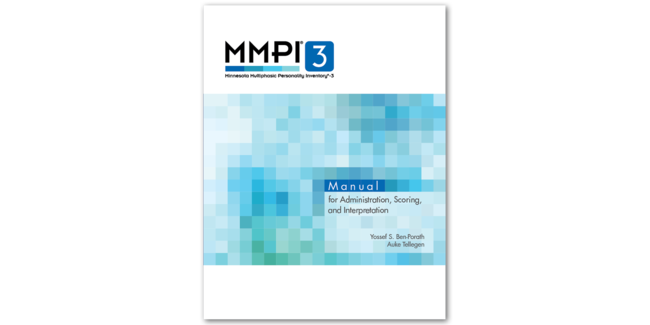
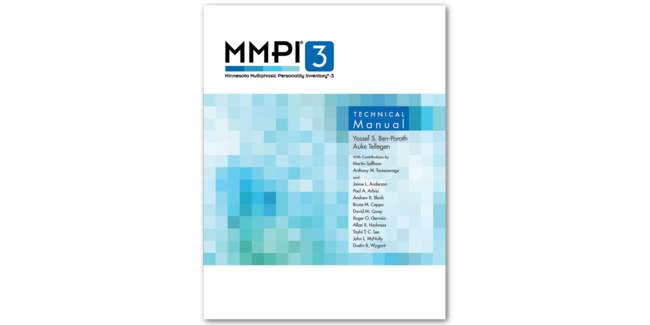
The Manual for Administration, Scoring, and Interpretation provides guidelines for use of the MMPI-2-RF, as well as scoring keys, T-score conversion tables, and itemmetric data. The Technical Manual details the conceptual foundations of the test, describes the development of the 50 MMPI-2-RF scales, and provides extensive empirical correlates and descriptive data for the scales in a broad range of settings. The two manuals complement each other and all users of the MMPI-2-RF need to be familiar with their content. The User’s Guide for Reports provides information on the development, composition, and use of the computer-based Score Report and Interpretive Report. It is recommended documentation for all users of these reports. Listed below is a summary of the table of contents for these three documents.

MMPI-2-RF Manual for Administration, Scoring, and Interpretation:

  • Introduction
  • Intended uses, user qualifications, and protection of test materials
  • The normative sample and derivation of standard scores
  • Procedures for administration and scoring
  • Test interpretation
  • Appendixes:
    • T-score conversions
    • Scoring keys
    • Scale membership and scored direction
    • Item content and reading level
    • Item conversion tables

MMPI-2-RF Technical Manual:

  • Introduction
  • Scale development
  • Psychometric properties and empirical correlates
  • Appendixes:
    • External correlates
    • Conversion of raw score means and standard deviations to T-score values
    • MMPI-2/MMPI-2-RF booklet and normative comparability
    • Comparison group T-score means and standard deviations
    • MMPI-2-RF/MMPI-2 scale correlations

MMPI-2-RF User’s Guide for Reports:

  • Introduction
  • The Score Report
  • Comparison group data development and use
  • The Interpretive Report
  • Generating reports and converting records
  • Tables:
  • o Demographic characteristics of the comparison groups o Scales considered in the substantive scale interpretation section (Interpretive Report) o Possible diagnostic considerations (Interpretive Report)

Where can I find further information about the MMPI-2-RF Interpretive Report?

The User's Guide for the MMPI-2-RF Interpretive Report is available from Pearson.

Ben-Porath, Y. S. & Tellegen, A. (2008). MMPI-2-RF User's Guide for Reports. Minneapolis, MN: University of Minnesota Press.

Where can I find information about the content validity, construct validity, and criterion validity of the MMPI-2-RF instrument?

The Technical Manual for the test, available from Pearson, contains extensive information on the validity of the MMPI-2-RF scales in a broad range of settings.

Tellegen, A. & Ben-Porath, Y.S. (2008). MMPI-2-RF Technical Manual. Minneapolis, MN: University of Minnesota Press.

Do the MMPI-2-RF manuals contain tables showing the MMPI-2-RF item numbers in order, followed by the MMPI-2 item numbers and vice versa?

Yes, in Appendix E of the MMPI-2-RF Manual for Administration, Scoring, and Interpretation (2008).

Administration, Scoring, and Interpretation Help and other Information

How can I administer the MMPI-2-RF?

The test can be administered with a booklet and answer sheet or “on-screen” using the Q Local software. On-screen administration offers several advantages including reduced administration time, no requirement to enter item responses into the scoring system (saving time and eliminating error), and immediate availability of test results.

How long does it take to administer the MMPI-2-RF?

The average time for booklet administration is 35-55 minutes and for on-screen administration it’s 25-35 minutes.

Can I administer the MMPI-2 test booklet and score the MMPI-2-RF?

Yes, if you use Q Local to score the MMPI-2, it is possible to convert the protocol into the MMPI-2-RF and generate a Score or Interpretive Report. The procedure for converting from MMPI-2 to MMPI-2-RF results is described in the User’s Guide for Reports.

Can I administer the MMPI-2 test booklet and hand score the MMPI-2-RF?

No, there are no hand-scoring templates for the MMPI-2-RF based on the MMPI-2 answer sheet. The only way to score the MMPI-2-RF based on an MMPI-2 test booklet administration is with the Q Local software.

Can I administer an “abbreviated” MMPI-2 test (first 370 items only) and score the MMPI-2-RF?

No. The MMPI-2-RF is composed of items throughout the entire MMPI-2 test booklet.

Can adolescents take MMPI-2-RF?

The MMPI-2-RF normative sample includes individuals 18 years and older and is not appropriate for younger individuals. The MMPI-A™ normative sample includes 14-18 year-old individuals and is the test recommended for use with that group.

Has the MMPI-A also been restructured?

Research to develop a restructured version of the MMPI-A is being planned. At this point the MMPI-A is the recommended version of the MMPI for use with adolescents.

Can I use the MMPI-2-RF instrument in compliance with the ADA (Americans With Disabilities Act) and Civil Rights Act?

Pearson cannot offer legal advice. We recommend that you seek the opinion of competent employment counsel to ensure that you obtain the most appropriate advice for your individual circumstances. We can note, however, that the ADA's apparent impact on the use of the MMPI-2-RF instrument relates to the timing of administration. The MMPI-2-RF instrument meets the definition of a medical examination as defined by the Equal Employment Opportunity Commission (EEOC) under the ADA, and hence must be administered subsequent to a conditional offer of employment being tendered by an employer. Under the Civil Rights Act of 1991 ("CRA") it is inappropriate to use either race or sex norms when utilizing tests in the employment domain. The MMPI-2-RF norms are not based on race or sex.

Is the MMPI-2-RF a replacement for the MMPI-2?

No. The MMPI-2 test will continue to be published and supported fully by the University of Minnesota Press and distributed exclusively by Pearson.

Is the MMPI-2-RF available in Spanish and other languages?

The MMPI-2-RF booklet will be available only in English initially. Translations, among them Spanish, will be available within a few years following publication. It is possible to administer a translated version of the MMPI-2 and use the Q Local software to generate MMPI-2-RF results following the protocol conversion procedures described in the User’s Guide for Reports.

What is the reading level of the MMPI-2-RF?

Most of the MMPI-2-RF items can be read by individuals with a fourth or fifth grade reading level. However, to ensure adequate reading ability, the recommended reading level for the MMPI-2-RF is the same as for the MMPI-2, at least sixth grade. A detailed discussion of this topic, including a comparison with other tests purported to require a lower reading level, is provided in the Manual for Administration, Scoring, and Interpretation.

Can the MMPI-2-RF Interpretive Report serve as a complete and independent psychological report on a client?

No. As noted on each report: “The interpretive report is intended for use by a professional qualified to interpret the MMPI-2-RF. The information it contains should be considered in the context of the test taker’s background, the circumstances of the assessment, and other available information.” The interpretive report is not intended to serve as an independent or stand-alone report.

Can I exchange unused MMPI-2 report usages for MMPI-2-RF usages?

Yes. Please call us at 1-800-627-7271 to exchange unused MMPI-2 usages on your Q Local software. The MMPI-2 Extended Score Report can be exchanged for the MMPI-2-RF Score Report and the MMPI-2 interpretive reports can be exchanged for the MMPI-2-RF Interpretive Report one-for-one at no additional charge.

Can I print an MMPI-2 report and an MMPI-2-RF report for the same test taker?

Yes, the “MMPI-2 to MMPI-2-RF Conversion Program” (included with Q Local software versions 2.2 and higher) translates data from a scored/processed MMPI-2 administration to create an MMPI-2-RF protocol. An MMPI-2-RF usage will be required to generate the MMPI-2-RF report for the test taker’s administration.

Are all MMPI-2-RF scales copyrighted?

Yes.

Where can I find information on upcoming MMPI-2-RF workshops?

To view a complete MMPI-2-RF workshop schedule, visit http://www.pearsonassessments.com/news/shows.htm

What scoring options are available for the MMPI-2-RF?

Hand scoring, mail-in scoring, and desktop computer-based scoring and reporting with Q Local software are available for the MMPI-2-RF.

What is an annotated interpretive report?

Annotation is an optional feature of the MMPI-2-RF interpretive report (available at no additional cost) that indicates for each statement in the interpretive report the scale(s) and scores that generated it and whether the statement is based on item content themes, empirical correlates, or inferences made by the report authors. For empirical-correlate-based statements, references are provided to the research literature in which they appear.

Do I need to buy new software to administer and score the MMPI-2-RF?

If you are a Q Local software user, you do not need to buy additional software. An update CD will be sent to all MMPI-2 customers who have Q Local software. There is no cost for this CD. The MMPI-2-RF will be added to the list of available tests in Q Local software upon installation of this version, the 2.2 CD. New Q Local software systems with the MMPI-2-RF will be available for purchase when the test is released.

Is the MMPI-2 more or less valid than the MMPI-2-RF?

The MMPI-2 is the most widely used and studied measure of personality and psychopathology. One of its main strengths, is the broad and extensive empirical literature available to guide interpretation of scores on the test. The MMPI-2-RF scales were developed with modern psychometric techniques that were not available to the developers of the original MMPI. The Technical Manual provides extensive data on the reliability and validity of these scales in a broad range of settings where the test is intended for use. The Validity Scales sets of the two instruments are very similar and comparably valid. The MMPI-2 Clinical Scales have several acknowledged shortcomings (described in the MMPI-2-RF Technical Manual), which were addressed in the development of the MMPI-2 Restructured Clinical (RC) Scales that are available in both versions of the test. The RC Scales and the additional substantive scales of the MMPI-2-RF together provide a comprehensive and efficient measurement of the constructs assessed by the MMPI-2 item pool.

Can the MMPI-2-RF be used in forensic assessments?

Yes, the Technical Manual provides extensive data on the reliability and validity of the MMPI-2-RF scales in a broad range of settings, including civil and forensic assessment samples.

What is the research base for the MMPI-2-RF?

Documentation of the research conducted to develop the MMPI-2-RF as well as extensive data on the reliability and validity of the 50 scales of the test are provided in the Technical Manual, which includes extensive empirical correlate data from outpatient and inpatient mental health, substance abuse treatment, medical, and civil and criminal forensic settings. The Technical Manual also provides descriptive scale statistics for these settings as well as for personnel screening settings. In addition, the Restructured Clinical (RC) Scales, which are identical on the MMPI-2-RF and on the MMPI-2, have been researched extensively in a broad range of other settings and samples. A bibliography of MMPI-2-RF research can be found at:
http://www.pearsonassessments.com/resources/mmpi2_rcscales-bib.htm

Are there new test items on the MMPI-2-RF?

No, the MMPI-2-RF is composed of 338 test items that were taken from the 567 items of the MMPI-2.

Do the MMPI-2-RF Scales overlap?

There is no overlap within the various sets of MMPI-2-RF scales. On the Validity Scale profile, the inconsistent responding indicators (VRIN-r and TRIN-r) do not overlap, nor do the three infrequent response indicators (F-r, Fp-r, and Fs) nor the under-reporting indicators (L-r and K-r). FBS-r, which is a multifaceted validity indicator, includes four items scored also on infrequent responding indicators and five items scored on under-reporting scales.

There is no overlap within the three levels of measurement of the substantive scales (i.e., within the three Higher-Order Scales, the nine Restructured Clinical [RC] Scales, or the 25 Specific Problems and Interest Scales). As is the case with other instruments that have a hierarchical structure, there is overlap between scales across the three levels of measurement. There also is no overlap between the five PSY-5 Scales. However these scales do overlap with other MMPI-2-RF measures.

I’m interested in conducting research on the MMPI-2-RF, who can help me with this?

Contact Beverly Kaemmer, manager of the Test Division at the University of Minnesota Press:

Email: kaemm002@umn.edu
Mailing address:
University of Minnesota Press
111 Third Avenue South, Suite 290
Minneapolis, MN 55401-2520

Adult Personality - Adolescent Personality - Biopsychosocial - Careers - Achievement/Cognitive
Home - News - Products A to Z - Ordering - Resources - Scoring - Support - Contact